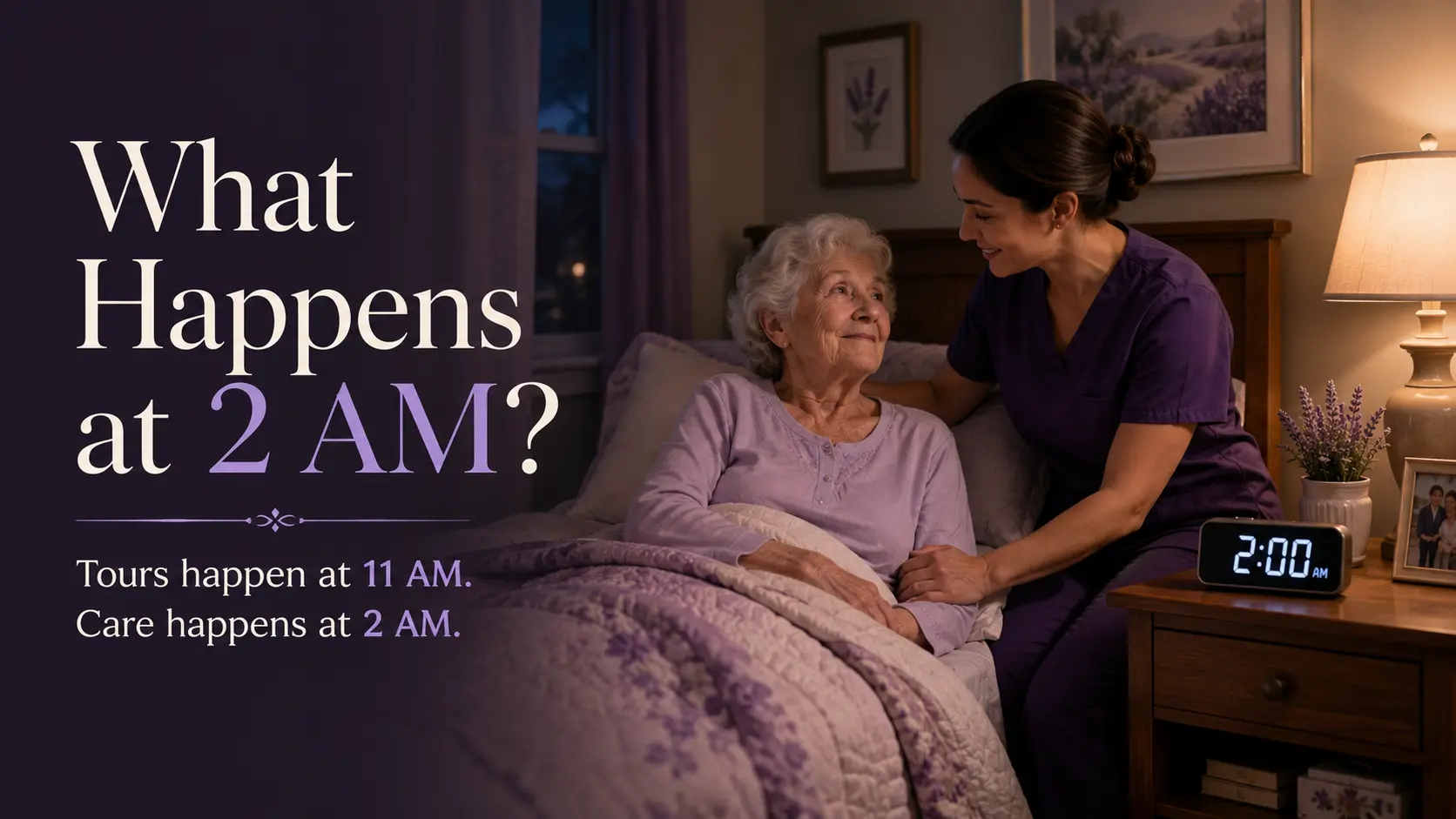
What Happens at 2 AM?
Tours happen at 11 a.m.
Care happens at 2 a.m.
When families tour a residential assisted living community, they usually visit during the most active and polished part of the day. The lobby is bright. The dining room is prepared for lunch. Activities are underway. Leaders are available to answer questions. Residents may be gathered in common spaces, and caregivers are visible throughout the building.
It can feel welcoming, organized, and reassuring.
But an assisted living decision should never be based only on what a community looks like during a scheduled daytime tour.
The real test often comes hours later, when the lights are dim, most residents are asleep, and staffing levels may be very different.
What happens when Mom needs help at 2 a.m.?
Who hears her?
Who responds?
How many other residents is that caregiver responsible for?
And how long will Mom wait before someone reaches her?
These questions reveal far more about the quality of residential assisted living than chandeliers, fireplaces, fitness rooms, or restaurant-style menus ever could.
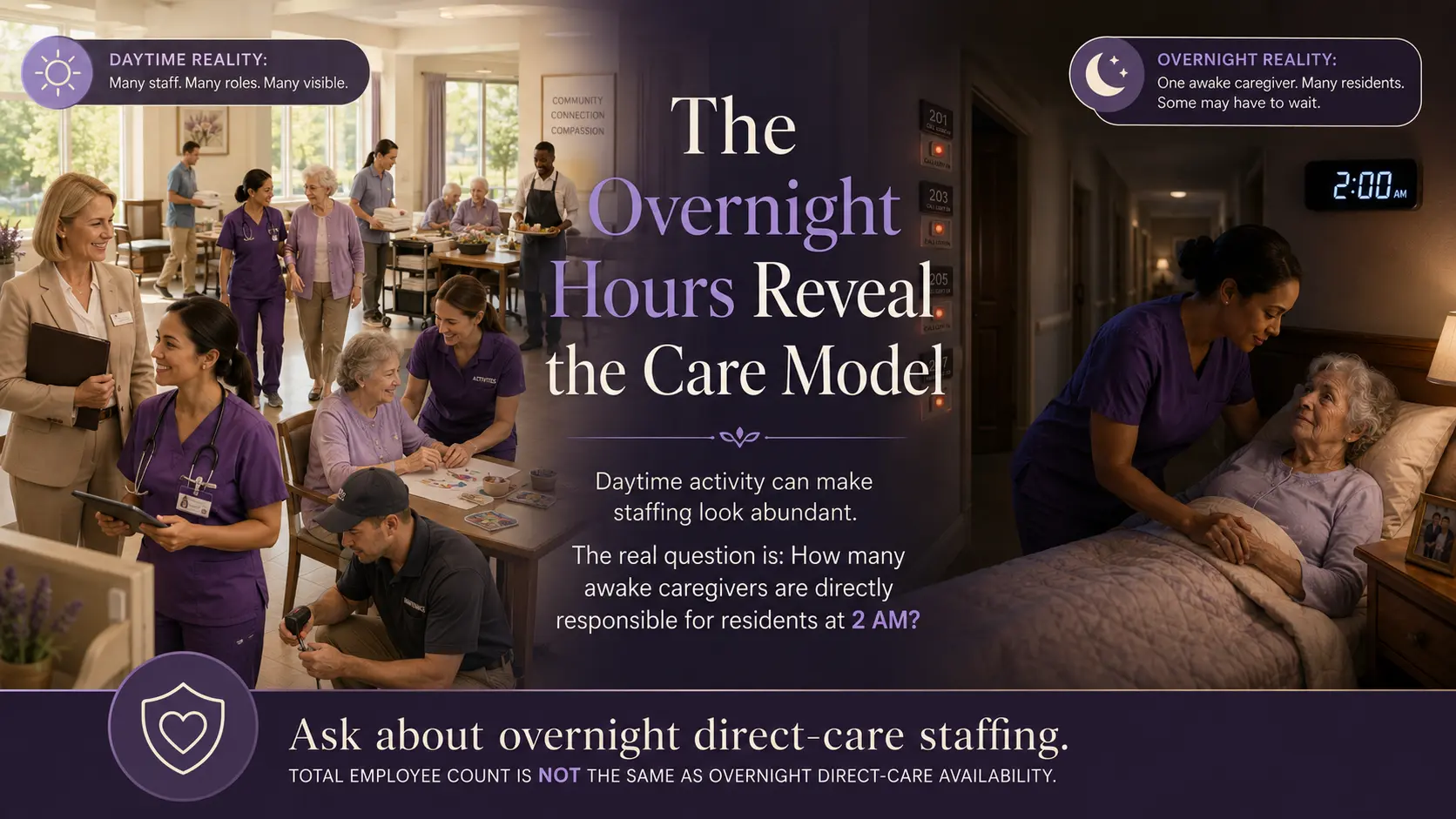
The Overnight Hours Reveal the Care Model
During the day, assisted living communities may have administrators, nurses, activity staff, housekeepers, maintenance employees, dining teams, marketers, and caregivers moving throughout the property.
That creates the appearance of abundant staffing.
However, many of those employees are not responsible for direct personal care. They may not help residents use the bathroom, change clothing, reposition in bed, manage confusion, or respond to urgent needs.
At night, the number of people inside the building often decreases dramatically.
That is why families should ask specifically about overnight direct-care staffing rather than accepting a general statement about total employee numbers.
A community might say it has 100 or even 200 employees. That sounds impressive, but it does not answer the question that matters most:
How many awake caregivers are directly responsible for residents at 2 a.m.?
In a large facility, one caregiver may be assigned to a hallway, wing, or floor containing many residents. If several people need help at the same time, someone will have to wait.
That wait may be inconvenient for one resident and dangerous for another.
Why Residents Need Help Overnight
Older adults do not stop needing care when the daytime shift ends.
Overnight support is an essential part of residential assisted living because residents may need help with:
- Comfort and love
- Using the bathroom
- Changing wet clothing or bedding
- Repositioning to reduce discomfort
- Managing pain
- Getting a drink of water
- Recovering after a bad dream
- Navigating confusion or anxiety
- Returning safely to bed
- Responding to a fall
- Addressing breathing concerns
- Managing wandering or restlessness
- Receiving scheduled medications
- Coping with symptoms related to dementia
For residents living with memory loss, nighttime can be especially difficult. A person may wake up disoriented and forget where they are. They may believe they need to go home, find a spouse, prepare for work, or check on their children.
In those moments, they need more than someone who can silence an alarm. They don’t need a caregiver who is too busy or asleep.
They need a caregiver who understands their history, recognizes their patterns, and knows how to offer reassurance without escalating fear.
That kind of response requires time, familiarity, and sufficient staffing.
A Call Button Is Only the Beginning
Many communities emphasize emergency pendants, pull cords, bedside buttons, or motion sensors during tours. Technology can certainly support resident safety, but it cannot replace available caregivers.
A call system can alert someone that help is needed.
It cannot guarantee that a caregiver is immediately free to respond.
Imagine that one overnight caregiver is helping a resident who requires two-person support in the bathroom. At the same time, another resident presses a call button after waking up confused. Then a third resident tries to stand without assistance.
The technology may work perfectly.
Every alarm may activate exactly as designed.
The problem is that there may not be enough people available to respond.
Families should therefore look beyond whether a residential assisted living community has call buttons. They should ask how quickly caregivers typically respond overnight and what happens when multiple residents need assistance simultaneously.
A system is only as effective as the people available to act on it.
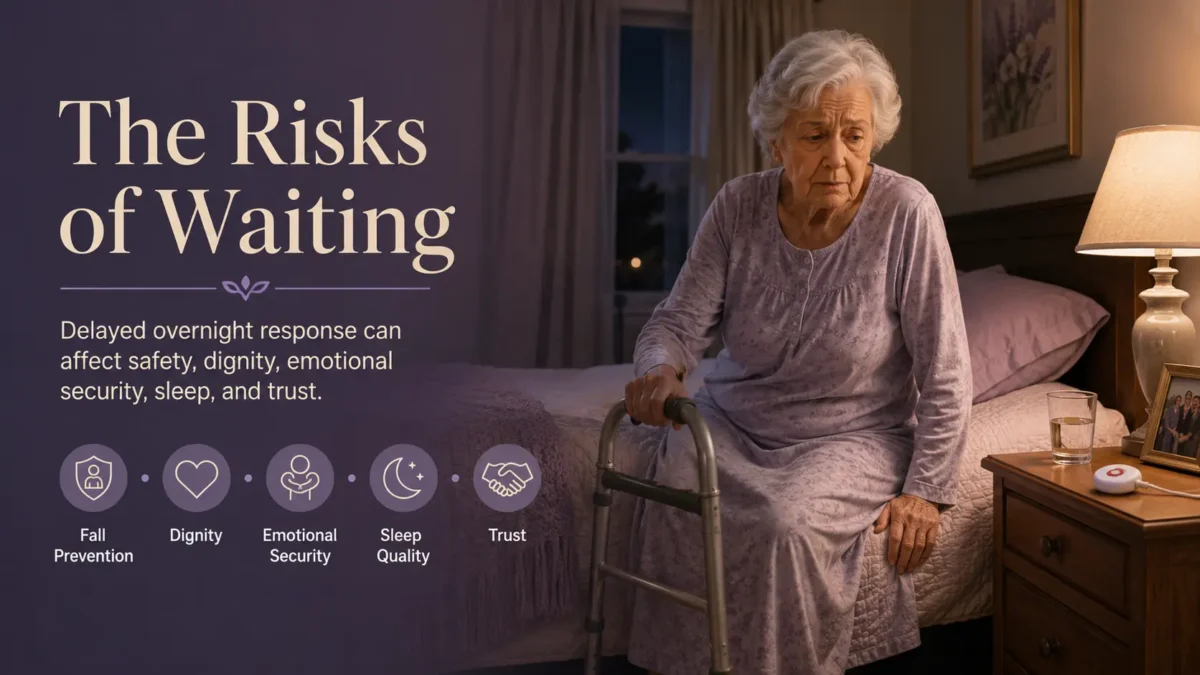
The Risks of Waiting
Waiting for care can have physical and emotional consequences.
A resident who needs help using the bathroom may eventually attempt to stand alone. That decision may lead to a fall, injury, or hospitalization.
A resident who is wet or uncomfortable may remain in soiled clothing longer than they should, increasing the risk of skin irritation and compromising dignity.
A person experiencing confusion may become increasingly frightened when no familiar face arrives. What began as mild disorientation may develop into agitation, yelling, wandering, or resistance to care.
Repeated delays can also teach residents that asking for help does not work.
Some may stop using their call buttons because they believe nobody will come quickly. Others may attempt more tasks independently, even when doing so is unsafe.
Responsive overnight care is not simply about convenience.
It is about fall prevention, dignity, emotional security, continence support, sleep quality, and trust.
Questions Every Family Should Ask
When comparing residential assisted living options, families should ask direct questions about overnight operations.
Start with one simple question:
Who is awake overnight?
Do not assume that someone is actively monitoring residents simply because employees are present in the building. Ask whether caregivers remain awake for the entire shift and whether any staff members have sleeping responsibilities.
Next, ask:
How many residents is each overnight caregiver assigned to?
The answer should be clear and specific. Statements such as “We staff according to need” or “There is always someone available” do not tell you how many residents one caregiver may be supporting.
Also ask:
What is the typical overnight response time?
Families should understand how response times are measured and what happens when several call systems activate at once. Always ask to see the data. The community can share its call response data.
Additional questions may include:
- Is the overnight staffing ratio different from the daytime ratio?
- Are two caregivers available when a resident requires two-person assistance?
- Who responds when a resident falls?
- How are residents with dementia monitored overnight?
- How often are safety checks completed?
- Are the same caregivers regularly assigned to the home?
- How are overnight incidents communicated to families?
- Is a nurse physically present, on call, or available remotely?
- What happens if a caregiver calls out sick?
- Can families review staffing levels for every shift?
A trustworthy provider should be willing to discuss these questions openly.
Why Smaller Residential Settings Can Make a Difference
Residential assisted living provided in a smaller home environment can create important advantages during overnight hours.
In a small-home model, caregivers may be responsible for fewer residents within a more manageable physical space. Bedrooms are often located closer to shared areas, making it easier for staff to hear movement, notice changes, and reach residents quickly.
Caregivers may also know each resident more personally.
They may recognize that one resident usually wakes around midnight for the bathroom. They may know that another becomes anxious after a vivid dream. They may understand which words calm a resident with dementia and which approaches cause frustration.
This familiarity allows care to become proactive rather than purely reactive.
Instead of waiting for a resident to become distressed enough to press a button, a caregiver may notice subtle movement, restlessness, or a change in routine and offer assistance before a problem develops.
Smaller does not automatically mean better, and families should still verify staffing practices. However, a well-operated residential assisted living home may provide greater caregiver proximity, stronger relationships, and more individualized overnight attention than a large community where staff members must cover long hallways or multiple floors.
Tour the Care, Not Just the Building
A beautiful building can create a powerful first impression.
Families may notice granite countertops, landscaped courtyards, theaters, salons, and elegant dining rooms. Those features can make a community feel luxurious.
But luxury means very little when a resident is frightened, uncomfortable, or waiting for help in the middle of the night.
The greatest luxury in assisted living is time.
Time for a caregiver to respond.
Time to help without rushing.
Time to listen.
Time to provide reassurance.
Time to notice that something is different before it becomes an emergency.
When touring a community, try to imagine the building without the daytime activity. Picture the hallways at 2 a.m. Ask who is present, where they are located, and how quickly they can reach your loved one.
Do not only tour the décor.
Tour the staffing model.
Tour the overnight plan.
Tour the quality of care.
What Will Happen When Mom Calls?
Families deserve a clear answer to this question before choosing a residential assisted living community.
At Assured Senior Living, our small-home model is designed around close caregiver relationships, greater visibility, and personalized support. Our caregivers are not responsible for navigating enormous campuses or managing long hallways filled with residents they barely know.
They work in true home environments where residents can be known as individuals—their routines, preferences, stories, concerns, and changing needs.
We believe care should not depend on how long someone is willing to wait after pressing a button.
It should be proactive, personal, and grounded in relationships.
Before selecting an assisted living community, ask what happens at 2 a.m. Ask who is awake, how many residents they support, and how quickly they can respond.
Then choose a community whose answer gives you confidence—not only during the tour, but during the quietest and most vulnerable hours of the night.
To learn more about Assured Senior Living’s residential assisted living homes and our commitment to personalized care, schedule a private tour and meet the caregivers who will be there when your loved one needs them most.
Assured Senior Living. Love, it’s what we do.