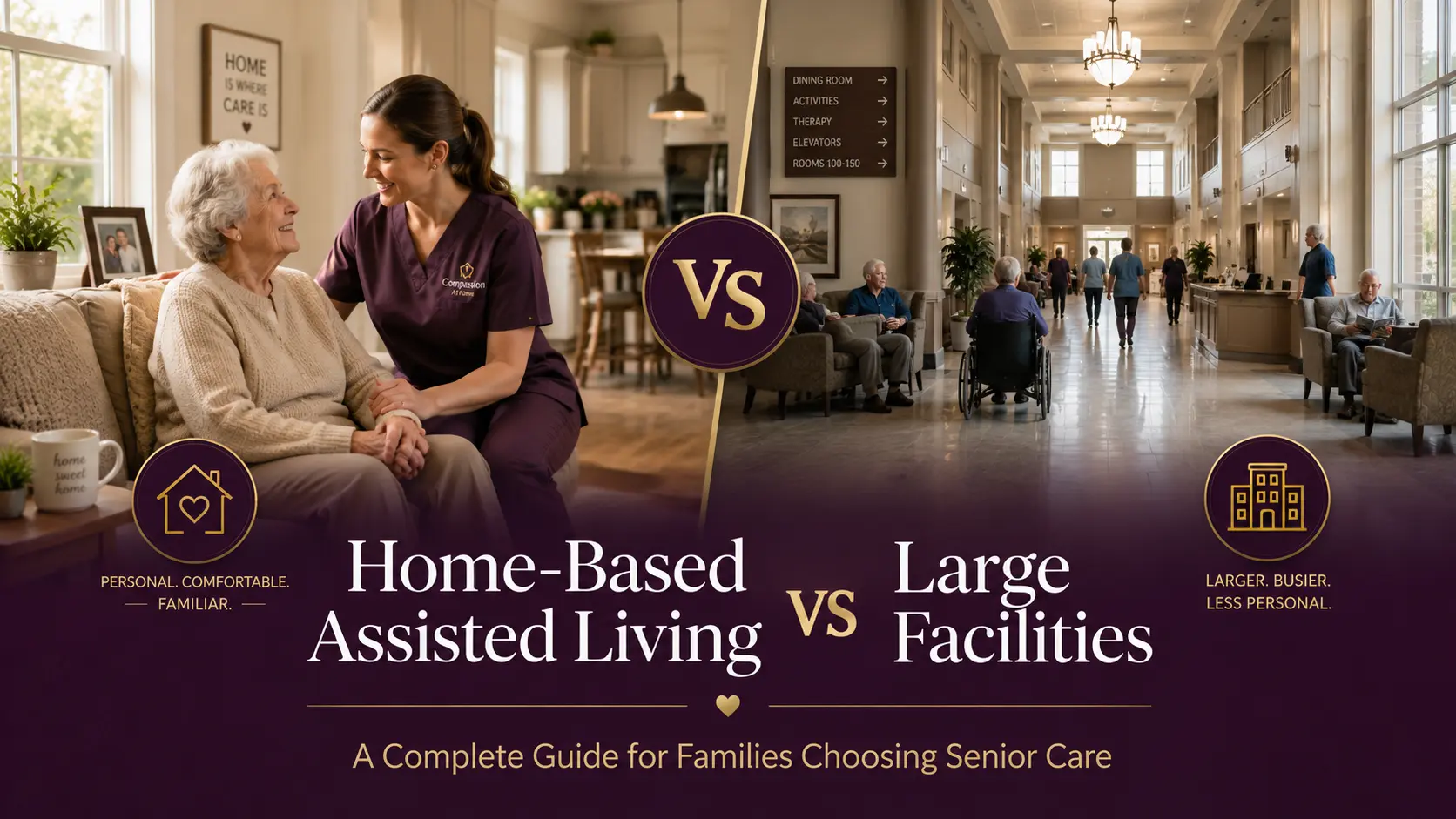
Home-Based Assisted Living vs Large Facilities: A Complete Guide for Families Choosing Senior Care
Choosing the right care for an aging parent is one of the most important—and emotional—decisions a family will ever make. Adult children often find themselves comparing numerous elderly care options, wondering which environment will provide the greatest safety, dignity, and quality of life.
Many families begin by searching online for senior care facilities or calling the big senior living community down the road, comparing prices, amenities, and locations. Yet one of the most significant decisions often receives the least attention: whether a loved one would thrive in home-based assisted living or in a large traditional senior living community. This comparison matters because the setting shapes daily life in very different ways. It also impacts their aging journey in so many ways.
While both models serve older adults who need assistance with daily living, they do so in very different ways. Understanding those differences can help families choose a setting that aligns with their loved one’s personality, health needs, and long-term well-being. With that in mind, it helps to first look at how each option works.
What Is Home-Based Assisted Living?
Home-based assisted living is a residential care model that serves a small number of residents in a real home rather than in a large institutional building. Instead of long hallways, multiple wings, elevators, and hundreds of apartments, residents live in a comfortable neighborhood home with personalized support available throughout the day and night.
These homes are licensed assisted living residences (just like the big ones) that provide help with:
- Medication management
- Bathing and dressing
- Mobility assistance
- Meal preparation
- Housekeeping and laundry
- Social & Community engagement
- Memory care for those living with dementia & Alzheimer’s
The environment feels familiar because it is a home. It’s not designed to be “home-like” because it is a true residential ranch-style home. Residents often gather around a kitchen table for meals, spend time in a shared living room, enjoy peaceful outdoor spaces, and develop meaningful relationships with caregivers and fellow residents.
For many families, this setting offers a more personal alternative to larger senior care facilities. Compared with a larger community, it often feels less institutional and more familiar.
What Are Large Senior Care Facilities?
Traditional senior living communities typically serve dozens—or even hundreds—of residents on a single campus. These communities may include independent living, assisted living, and memory care under one roof.
Large communities often feature amenities such as:
- Restaurants and cafés
- Fitness centers
- Movie theaters
- Beauty salons
- Activity calendars
- Transportation services
- Walking paths and landscaped campuses
These amenities can be appealing, particularly for active older adults who enjoy a wide variety of social opportunities. However, families should recognize that amenities and care are not the same thing. That distinction becomes important when evaluating daily support.
The quality of daily life depends not only on what a community offers but also on how care is delivered each day. For that reason, the next question is how each model approaches daily support.
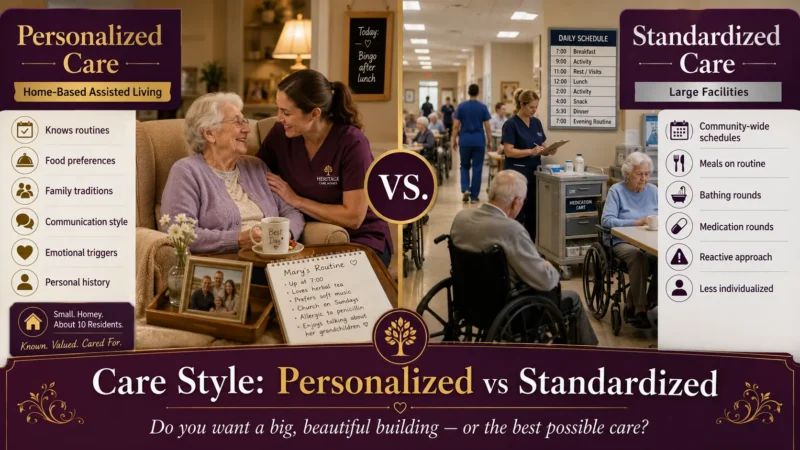
Care Style: Personalized Versus Standardized
Perhaps the greatest difference in any senior living comparison is the philosophy of care. That philosophy shapes everything that follows.
In home-based assisted living, caregivers typically support a small number of residents. For Assured Senior Living, the typical number of residents is around 10. This allows them to know each individual personally.
Caregivers learn:
- Favorite routines
-
- Also, ways to ensure the routines are honored and completed.
- Preferred wake-up times
- Food preferences
- Family traditions
- Communication styles
- Emotional triggers
- Personal history
Instead of following a rigid institutional schedule, care is often adapted around the resident. This creates a different daily rhythm than many larger communities provide.
Large communities generally rely on standardized schedules designed to meet the needs of many residents simultaneously. Large communities use a reactive, non-personalized approach. Meals, bathing schedules, medication rounds, and activities often follow community-wide routines.
Neither care model is inherently wrong, but families should consider whether their loved one benefits more from individualized flexibility or structured routines. An even bigger question is: Do I want a big, beautiful building for my loved one, or the best possible care? That question leads naturally into the daily experience of each setting.
The Daily Experience Looks Very Different
The physical environment influences nearly every aspect of a resident’s day. Because of that, the daily experience can feel very different from one setting to another.
In a home-based setting, mornings often begin naturally. They are not rushed but on the resident’s schedule. Residents may wake at their preferred time, enjoy breakfast together, chat with familiar caregivers, and move comfortably throughout the home.
The atmosphere is calm and predictable.
In larger communities, daily life often involves:
- Long and confusing walks to dining rooms.
- Multiple new caregivers throughout the day
- Busier common areas
- More residents sharing spaces
- Frequent transitions between activities and engagement
For outgoing seniors who enjoy large social environments, this may be energizing. But in the end, the outgoing senior must feel connected to those in the community. They must recognize and connect with the caregivers.
For someone living with dementia, anxiety, hearing impairment, or mobility limitations, the increased stimulation can become overwhelming.
The right environment depends on the individual. With that in mind, staffing is another important factor to compare.
Staffing Matters More Than Total Employees
One of the biggest misconceptions families have is assuming that a community with hundreds of employees automatically provides better care.
In reality, what matters most is the caregiver available to your loved one. That is why the details of staffing deserve close attention.
When comparing senior care facilities, ask questions such as:
- What is the caregiver-to-resident ratio during the day?
- What is the ratio overnight?
- Are the caregivers awake overnight?
- How many caregivers are assigned directly to residents?
- How long have your caregivers worked here?
- How often do residents see the same caregivers?
- At Assured Senior Living, our residents get to see the same 4 to 6 caregivers every week.
Consistency matters. When caregivers know residents well, they often notice subtle changes before they become larger medical concerns. This continuity also supports stronger relationships over time.
When caregivers know residents well, they often notice subtle changes before they become larger medical concerns. They can be proactive in their care, not reactive.
A caregiver who sees someone every day may recognize:
- Change in appetite
- Increased confusion
- Changes in walking or gait
- Mood shifts
- Sleep disturbances
- Early signs of illness
That familiarity supports proactive care rather than reactive care. It also helps explain why relationships matter so much in smaller settings.
Home-Based Assisted Living Encourages Meaningful Relationships
Relationships are among the greatest strengths of home-based assisted living.
Because residents interact with the same caregivers regularly, trust develops naturally over time.
Families also become familiar with caregivers.
Instead of wondering who is caring for Mom today, many families know each caregiver by name.
These relationships often reduce anxiety during transitions and create a genuine sense of community. In that way, the care experience feels more personal and connected.
Residents are not simply apartment numbers.
They become members of a household.
Understanding Assisted Living vs Nursing Home Care
Families frequently search for information about assisted living vs nursing home care.
Although these terms are sometimes used interchangeably, they serve different purposes. To compare them clearly, it helps to start with assisted living.
Assisted living is designed for individuals who need assistance with activities of daily living while maintaining as much independence as possible.
Residents typically receive support with:
- Bathing
- Dressing
- Medication reminders or administration
- Meals
- Housekeeping
- Personal care
Nursing homes provide a significantly higher level of medical care.
They are generally appropriate for individuals requiring:
- Skilled nursing services
- Complex medical treatments
- Rehabilitation following hospitalization
- Ongoing medical monitoring
- An extremely clinical environment with a different structure to the daily flow
For many seniors, assisted living offers the right balance between independence and daily support.
The decision is less about which option is “better” and more about matching medical and clinical needs. Once that is clear, families often begin comparing how home care services fit into the picture.
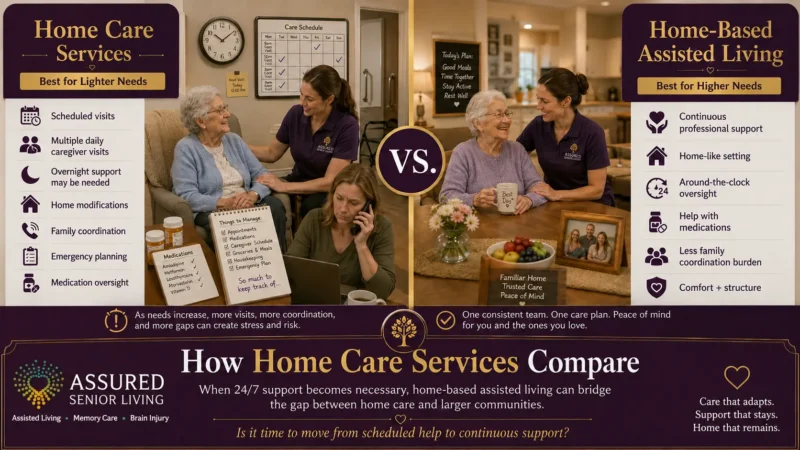
How Home Care Services Compare
Families also compare home care services with assisted living.
Home care allows seniors to remain in their own homes while caregivers visit at scheduled times.
This can work well when someone needs only a few hours of assistance each day.
However, as care needs increase, families often encounter new challenges. Those challenges can make the next stage of planning more complex.
Care may require:
- Multiple daily caregiver visits
- Overnight support
- Home modifications
- Family coordination
- Emergency planning
- Medication oversight
-
- Running and making sure all prescriptions are up to date and filled
When around-the-clock supervision becomes necessary, managing care at home can become increasingly complex. At that point, families often look for a setting that offers more continuous support.
Home-based assisted living offers many of the comforts of a residential home while providing continuous professional support in a structured care environment. For many families, that combination helps bridge the gap between home care and larger communities. This environment lets the residents thrive as though they were living in their own homes.
Which Seniors Thrive in Home-Based Assisted Living?
Many residents flourish in smaller residential settings, especially those who:
- Want a personalized and individualized experience.
- Prefer quiet environments
- Feel overwhelmed by crowds
- Live with Alzheimer’s disease or other dementias.
- Value close relationships
- Need consistent caregivers
- Require frequent assistance throughout the day.
- Enjoy a family-style atmosphere.
The familiar environment often reduces confusion and supports emotional comfort. That is why these qualities matter so much for certain residents.
Which Seniors May Prefer Larger Communities?
Large communities can be an excellent fit for seniors who:
- Are highly independent
- Enjoy large social events.
- Want numerous organized activities.
- Appreciate resort-style amenities
- Prefer apartment-style living
- Thrive in active community environments. For these seniors, the larger setting may feel like a better fit.
Neither model is universally superior.
The best choice depends on the individual rather than the building. With that in mind, families should ask practical questions before deciding.
Questions Every Family Should Ask
As you evaluate different elderly care options, look beyond brochures and beautiful buildings. The next step is to focus on how care actually works day-to-day.
Instead, ask questions that reveal how care is actually delivered.
Consider asking:
- How many residents does each caregiver support?
- How long have caregivers worked here?
- How consistent are the staff members?
- Are they the same caregivers every week?
- What training do caregivers receive?
- How are medical changes communicated to families?
- Is there a communication app to improve communication?
- How often are residents engaged throughout the day?
- How do you support residents with dementia?
- What happens overnight when a resident needs assistance?
- How do caregivers build relationships with residents?
The answers often tell a richer story than amenities alone. They also help families move from first impressions to a clearer decision.
The Right Decision Is About Fit, Not Size
Choosing senior living is about finding the environment where your loved one can feel safe, respected, connected, and cared for. In the end, fit matters more than size.
For some older adults, a vibrant campus with extensive amenities provides exactly what they need.
For others, home-based assisted living offers something that cannot easily be replicated in larger communities: familiarity, consistency, meaningful relationships, and deeply personalized care.
As you continue your senior living comparison, remember the most important question isn’t simply, “Which community is the nicest?” It is, “Which setting best fits your loved one’s needs, personality, and daily care requirements?” However, my favorite question to ask is, “What matters more: the big beautiful building or making sure my loved one has the best care and experience?”
Instead, ask:
“Where will my loved one be truly known?”
When caregivers know a resident’s story, preferences, routines, and personality, care becomes more than assistance with daily tasks—it becomes a relationship built on trust, dignity, and compassion.
Those human connections often make the greatest difference in a person’s quality of life, providing families with confidence that their loved one is not simply receiving care but is genuinely at home. These teams care deeply and lovingly for their residents.
To learn more about how Assured Senior Living creates a personalized aging experience, reach out to one of our experienced team members.