

Choosing Attentive Denver Assisted Living in 2026
Choosing assisted living for a parent is rarely just a housing decision. It is a decision about who will notice when your loved one is anxious, who will recognize a behavior change, and who will have enough time to respond when help is needed.
Families comparing assisted living facilities often begin with price, location, room size, dining options, and amenities. Those factors matter, but they do not always reveal what daily life will actually feel like for the resident.
The more important question may be:
Will caregivers have enough time and attention to know my loved one truly?
For adult children seeking senior care in Denver, caregiver availability should be one of the most important parts of the evaluation process. A beautiful building cannot replace attentive caregivers. A long activity calendar cannot compensate for rushed personal care. An emergency call system means little if residents must wait for someone to respond.
The following guide will help families evaluate caregiver-to-resident attention, compare home-based care with larger communities, and identify the signs of genuine assisted living quality during a tour.
Why Caregiver Attention Matters
Older adults do not simply need tasks completed. They need caregivers who understand how they prefer those tasks to be completed.
One resident may become anxious when rushed during dressing. Another may need extra encouragement to eat. Someone living with dementia may resist bathing with an unfamiliar caregiver but cooperate comfortably with someone they trust. A resident recovering from an injury may require patience, reassurance, and close observation while moving through the home.
These details are difficult to learn when caregivers are responsible for too many residents.
An attentive caregiver may notice that a resident:
- Is eating less than usual
- Appears more tired or confused
- Is walking differently
- Has become unusually quiet
- Is avoiding social interaction
- Is showing early signs of illness
- Needs more assistance than the previous day
Those observations can help families and care teams respond before a small change becomes a larger concern.
Consistency and familiarity are especially important for residents living with dementia, Parkinson’s disease, brain injuries, mobility challenges, or communication difficulties. In these situations, caregiver attention is not an optional amenity. It is a central part of safe and compassionate elderly care services.
Understand the Caregiver-to-Resident Ratio
The caregiver-to-resident ratio describes how many residents each direct-care caregiver is responsible for during a particular shift.
For example, a ratio of one caregiver for four residents is very different from one caregiver for twelve or more residents. Even when both communities describe themselves as fully staffed, the individual caregiver’s workload may be dramatically different.
However, families should not accept a single ratio without asking follow-up questions.
Ask:
- Does that number include administrators, cooks, housekeepers, or maintenance employees?
- Is it the direct-care ratio or the total employee count?
- Does the ratio change at night?
- What happens when a caregiver calls out?
- Are caregivers assigned to specific residents or the entire building?
- How many residents require two-person assistance?
- Who responds when several residents need help at the same time?
Some assisted living facilities may promote a large total number of employees. Yet many of those employees may not provide hands-on assistance with bathing, dressing, toileting, mobility, or medication routines.
Families should focus on the number of available direct-care caregivers and the number of residents those caregivers are actively supporting.
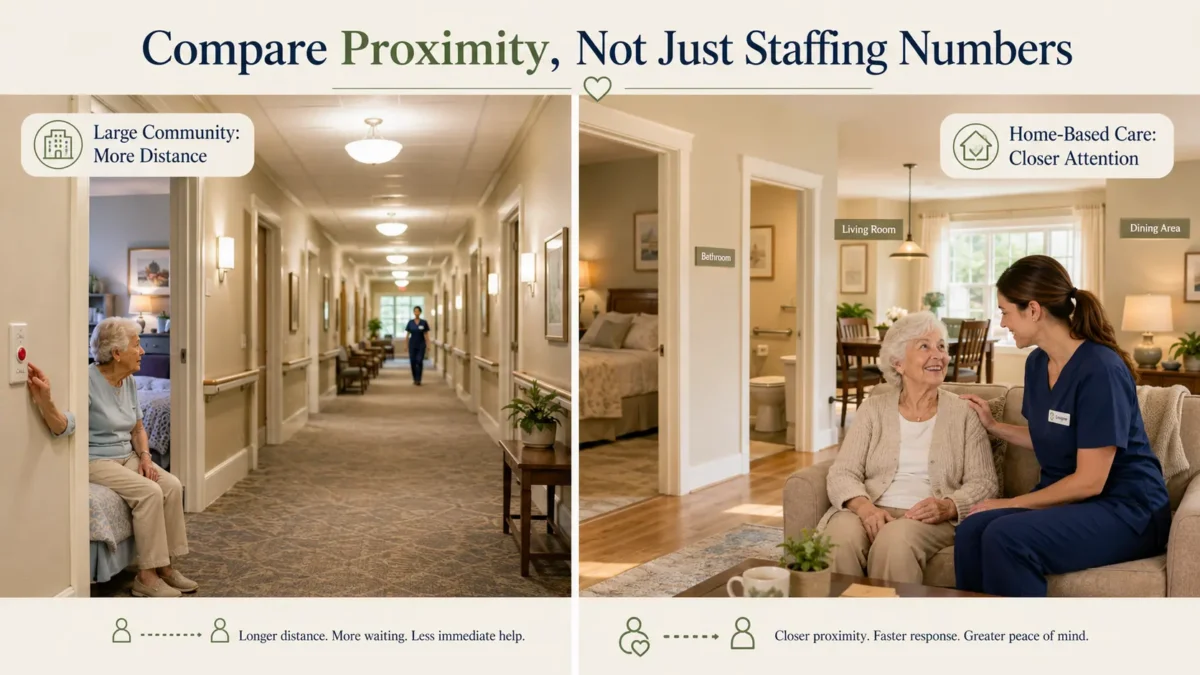
Compare Proximity, Not Just Staffing Numbers
Caregiver attention depends on more than the number of people working. It also depends on where those caregivers are located.
In a large community, a caregiver may be responsible for residents spread across a hallway, floor, wing, or multiple common areas. Even a reasonable staffing ratio can feel inadequate when caregivers must walk long distances between residents.
Smaller residential homes may reduce those physical barriers. In a home-based care setting, caregivers are often closer to bedrooms, bathrooms, living rooms, and dining areas. They may hear changes in a resident’s voice, notice someone struggling to stand, or recognize that a resident has not joined the group for lunch.
When touring, imagine the setting during the quietest hours of the day.
Ask yourself:
- Can caregivers easily see and hear residents?
- How far is the nearest caregiver from the bedrooms?
- Are there blind hallways or isolated areas?
- Would my parent need to rely on a call button for routine support?
- How long would it take someone to reach the room at night?
The physical layout of an assisted living community can either support attentive care or make that care more difficult.
Observe What Caregivers Are Doing
A scheduled tour usually includes polished common areas, friendly introductions, and a prepared explanation of services. While listening to the presentation, pay close attention to what is happening around you.
Notice whether caregivers are:
- Speaking to residents by name
- Sitting and engaging in conversation
- Offering help before residents request it
- Rushing from one task to another
- Looking at residents when speaking
- Explaining what they are doing during personal assistance
- Responding calmly when a resident appears confused
- Familiar with individual routines and preferences
Also observe the residents.
Do they appear comfortable around the caregivers? Are they participating in the life of the home? Do they seem clean, appropriately dressed, and emotionally at ease? Are residents waiting unattended near bathrooms, dining areas, or doorways?
One isolated moment does not tell the whole story. However, repeated patterns can reveal whether the community is organized around relationships or around completing tasks as quickly as possible.
Ask How Caregivers Learn About Residents
Attentive care requires personal knowledge.
Caregivers should know more than a diagnosis and medication list. They should learn how each resident communicates, what causes stress, which foods they enjoy, how they prefer to spend the day, and what helps them feel secure.
Ask the community:
- How do caregivers learn my parent’s routines?
- How is personal information communicated between shifts?
- Will the same caregivers regularly work with my loved one?
- How do you document changes in mood, appetite, sleep, or mobility?
- How are families informed when something changes?
- What happens when a resident’s needs increase?
- How do you help new residents adjust during the first several weeks?
Listen for specific answers.
Statements such as “We provide personalized care” are not enough. The community should be able to explain how personalization happens in practice.
For example, a strong response may describe consistent caregiver assignments, detailed resident profiles, shift-to-shift communication, family updates, and care plan reviews. These systems help preserve knowledge and reduce the risk that important details will be lost.
Evaluate Caregiver Consistency and Turnover
A favorable caregiver-to-resident ratio has less value when the caregivers change constantly.
Frequent turnover can create confusion for residents and families. New employees must repeatedly learn personal routines, communication styles, safety risks, and emotional triggers. Residents may need to rebuild trust every time a familiar caregiver leaves.
Ask how long the current caregivers have worked in the home. Ask whether residents regularly see the same team members. Find out how temporary or agency staff are used.
For residents living with memory loss, consistency may reduce anxiety and help caregivers recognize subtle changes more quickly. A familiar caregiver knows what is normal for a particular resident. That knowledge makes it easier to identify when something is wrong.
Assisted living quality is often visible in the relationships between residents and long-term caregivers.
Tour During More Than One Time of Day
Most tours occur during business hours, when leadership staff is present, and the community is prepared for visitors.
Consider returning at a different time, such as during a meal, in the early evening, or on a weekend. These visits can provide a more complete picture of staffing and daily life.
Ask specifically about overnight care.
Questions should include:
- How many direct-care caregivers are awake overnight?
- How many residents are they supporting?
- Are caregivers assigned to one home, floor, or building?
- Who responds if two residents need assistance at once?
- How often are residents checked during the night?
- Is a nurse physically present or available by phone?
- What is the procedure when a resident falls or becomes ill?
Overnight staffing can reveal the true care model. Residents still need toileting assistance, reassurance, repositioning, supervision, and emergency support after administrative offices close.
Compare Home-Based Care With Larger Communities
Larger assisted living facilities may offer extensive amenities, multiple dining areas, fitness centers, theaters, salons, and large activity programs. Some families and residents may prefer that environment.
Smaller residential homes provide a different experience.
Home-based care may offer:
- Shorter distances between caregivers and residents
- Fewer residents sharing caregiver attention
- More consistent daily routines
- Familiar living and dining spaces
- Greater opportunity for caregivers to notice changes
- A quieter environment
- More individualized activities
- Stronger relationships between residents, families, and caregivers
Neither size alone guarantees quality. A small home can still be poorly managed, while a larger community can provide excellent care. Families must evaluate the actual staffing model, leadership, caregiver consistency, communication, and culture.
The goal is not simply to choose the smallest or largest option. It is to choose the environment where your loved one is most likely to be known, supported, and protected.
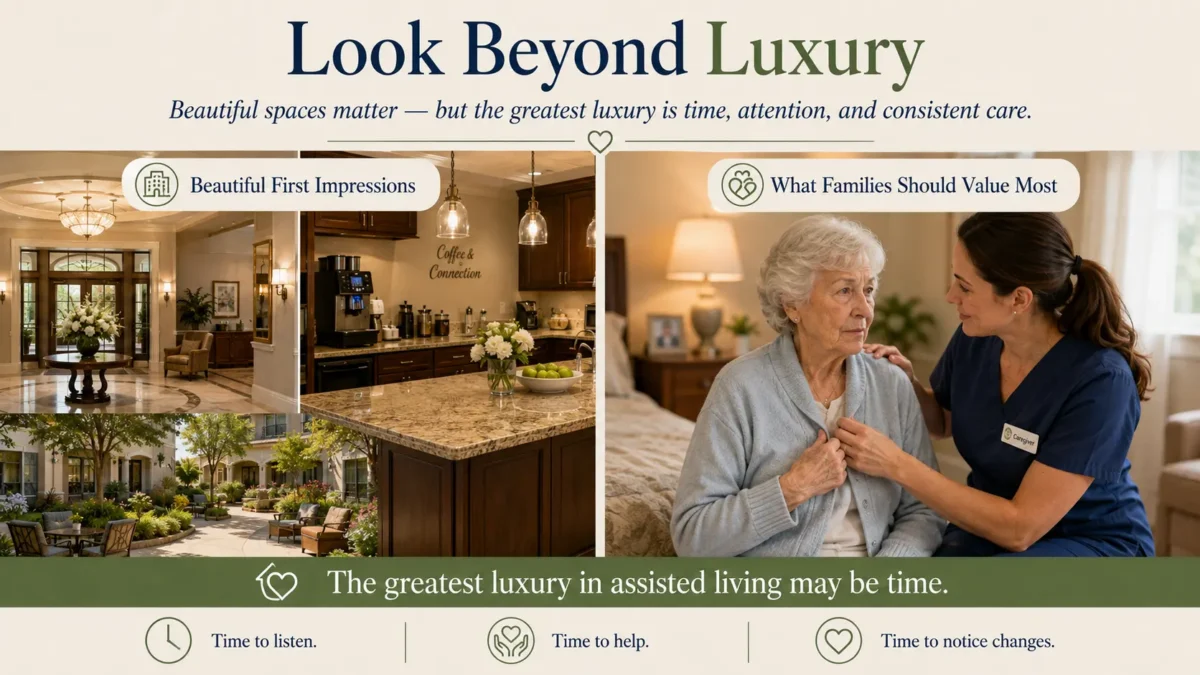
Look Beyond Luxury
Granite countertops, elegant entrances, coffee bars, and landscaped courtyards can create a strong first impression. But those features do not provide hands-on assistance.
The greatest luxury in assisted living may be time.
Time for a caregiver to sit with a frightened resident.
Time to help someone dress without rushing.
Time to encourage a resident to eat.
Time to listen to the same story again.
Time to notice that something has changed.
When comparing assisted living facilities in 2026, families should ask whether the community’s resources are primarily invested in appearances or in the people delivering care.
A beautiful environment can be valuable. It simply should not distract from the quality, availability, and consistency of the caregivers.
Choosing Senior Care in Denver With Confidence
Before making a final decision, compare each community using the same criteria. Write down the direct-care ratio for every shift, including nights and weekends. Record how long caregivers have worked there, how residents summon help, and how quickly support is typically available.
Pay attention to how the community makes you feel.
Are your questions welcomed? Are the answers clear? Does leadership seem transparent? Do caregivers appear calm and connected? Can staff describe residents as individuals rather than room numbers or diagnoses?
Trust is built through specific information, observable behavior, and meaningful relationships.
Discover the Assured Senior Living Difference
At Assured Senior Living, we believe attentive care begins with creating true home environments where caregivers have the opportunity to know each resident personally.
Our residential assisted living homes are intentionally designed to support proximity, familiarity, consistency, and meaningful connection. Our caregivers learn residents’ routines, preferences, abilities, personalities, and life stories. We do not believe older adults should have to wait for attention simply because they live in a care setting.
We encourage families to compare our caregiver-to-resident ratios, tour our homes, meet our teams, and observe the relationships between caregivers and residents.
Do not choose assisted living based only on the lobby, dining room, or activity calendar.
Choose the community where someone will notice.
Choose the home where someone will listen.
Choose the care team that will know your loved one.
Contact Assured Senior Living today to schedule a personal tour of one of our Denver-area residential homes and discover what attentive, relationship-based care can look like.
Love, it’s what we do.