Why Call Buttons Are a Symptom of the Problem
Walk through almost any large senior living community, and you’ll notice them right away.
Call buttons are beside every bed.
Emergency pull cords in every bathroom.
Wireless pendants hanging around residents’ necks.
They’re everywhere.
Most families see these devices and feel reassured. They think, “If Mom needs help, she can simply push the button.”
On the surface, that makes perfect sense.
But what if we’ve been asking the wrong question?
Instead of asking, “How quickly does someone respond when the button is pushed?” perhaps we should be asking, “Why does the resident need to push the button in the first place?”
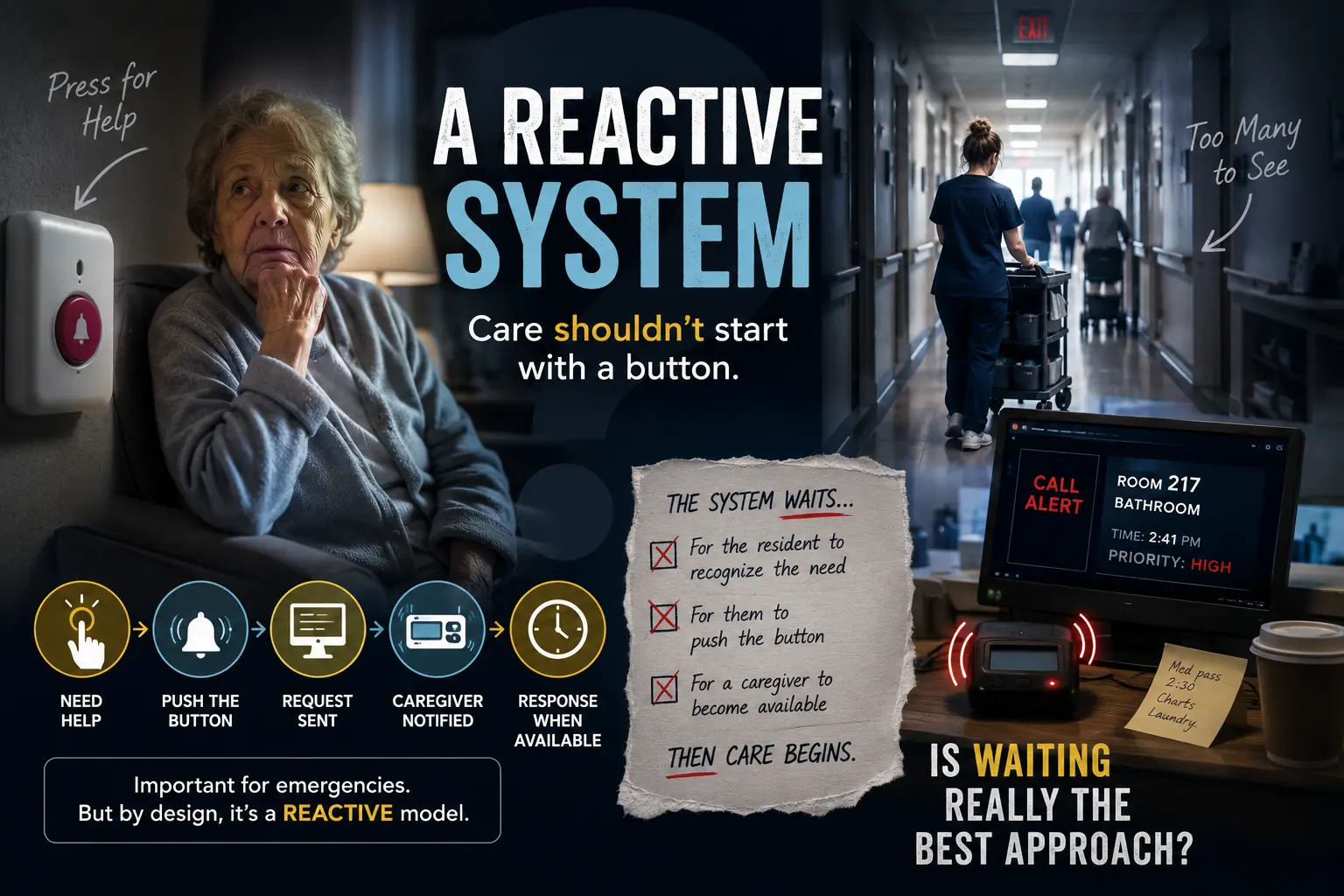
The answer reveals a fundamental difference in how senior living communities deliver care: call buttons are reactive.
A Reactive System
Call-button systems were designed to solve a very real challenge.
In many large communities, caregivers are responsible for numerous residents spread across long hallways, multiple floors, or even separate buildings. Even the most dedicated caregiver cannot continuously observe every resident.
Because caregivers cannot be everywhere at once, residents can request assistance.
The process is simple.
A resident needs help.
They push the button.
The request appears on a monitoring system or pager.
A caregiver finishes what they’re doing.
Then they respond.
This model isn’t inherently bad. In many situations, call systems are an important safety feature and should absolutely be available for emergencies. But it is, by design, a reactive model of care.
But it is, by design, a reactive model of care.
The system waits until something happens before anyone intervenes.
It waits for the resident to recognize they need help.
It waits for a caregiver to become available.
Then care begins.
The question families should ask is whether waiting is always the best approach, especially when call systems rely on residents to recognize and activate them.
The Challenge for Older Adults
Many residents living in assisted living or memory care don’t always ask for help when they need it. Some forget. Some don’t want to bother anyone. Some underestimate their limitations. Others living with dementia may not remember what the call button is for or may not recognize when they need assistance.
Some forget.
Some don’t want to bother anyone.
Some underestimate their limitations.
Others living with dementia may not remember what the call button is for or may not recognize when they need assistance.
A resident who attempts to get out of bed without asking for help isn’t trying to ignore instructions.
They may simply believe they’re still capable of doing what they’ve done independently for decades.
Unfortunately, that moment can quickly become a fall.
Others may become anxious, confused, or frightened and wander into hallways searching for a spouse, a parent, or a home they remember from many years ago.
These situations often develop long before anyone presses a button.
Sometimes, no button is ever pressed at all.
Care Begins Before the Request
At Assured Senior Living, we believe one of the greatest advantages of the small-home model is that caregivers spend less time walking long corridors between dozens of resident rooms. That means they can stay close enough to notice needs sooner.
Instead, they live alongside residents throughout the day.
They’re preparing meals in the kitchen.
They’re helping someone fold laundry.
They’re sitting together in the living room.
They’re assisting with activities around the dining table.
They’re present.
That presence changes everything.
Instead of waiting for a resident to request help, caregivers naturally notice when someone begins to struggle.
They notice when someone starts shifting uncomfortably in a chair.
They recognize when someone appears tired or unsteady.
They see when a resident is becoming anxious before that anxiety escalates.
They observe subtle changes in mood, appetite, or behavior that could indicate a developing medical concern.
Many needs are identified before they become emergencies.
Proactive Care Is Relationship-Based Care
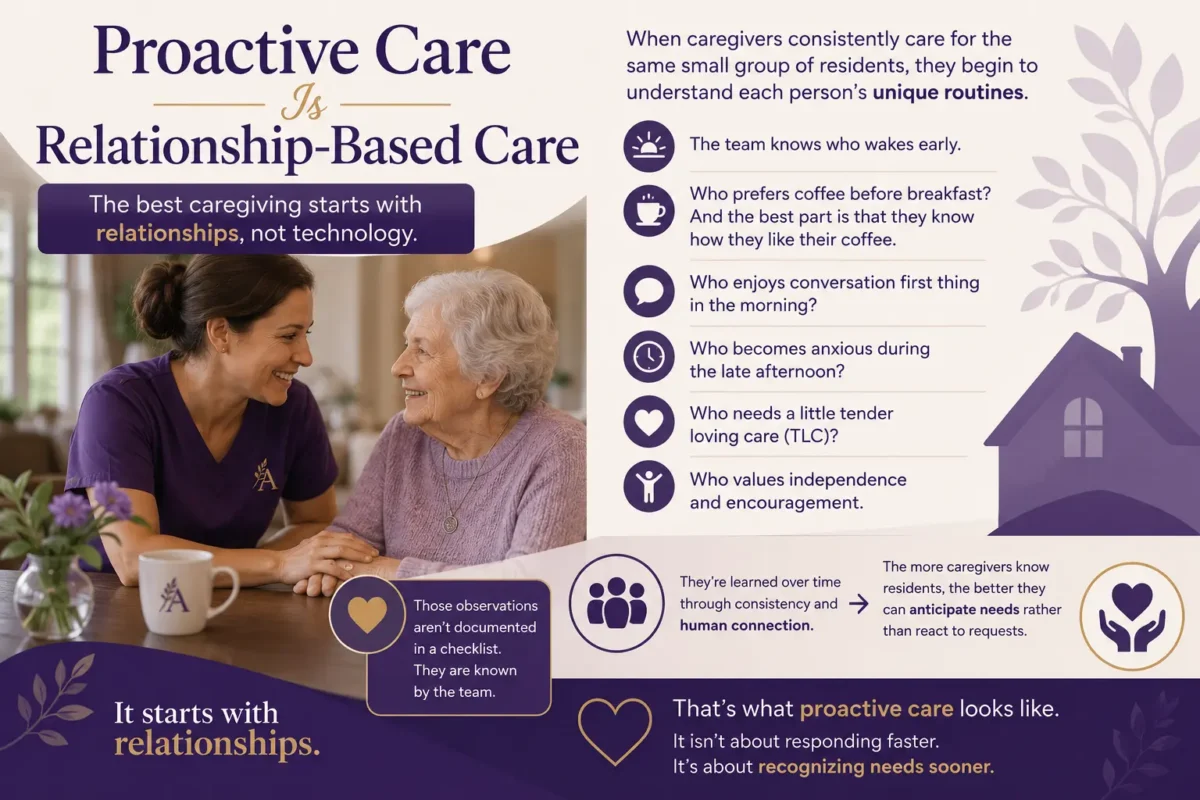
The best caregiving starts with relationships, not technology.
It starts with relationships.
When caregivers consistently care for the same small group of residents, they begin to understand each person’s unique routines.
The team knows who wakes early.
Who prefers coffee before breakfast? And the best part is that they know how they like their coffee.
Who enjoys conversation first thing in the morning?
Who becomes anxious during the late afternoon?
Who needs a little tender loving care (TLC)?
Who values independence and encouragement.
Those observations aren’t documented in a checklist. They are known by the team.
They’re learned over time through consistency and human connection.
The more caregivers know residents, the better they can anticipate needs rather than react to requests.
That’s what proactive care looks like.
It isn’t about responding faster.
It’s about recognizing needs sooner.
Presence Creates Peace of Mind
Families often tell us that one of their greatest concerns is whether someone will notice their loved one before problems grow worse, not just whether someone will respond in an emergency. Families want to feel that a team is invested in their loved one. They don’t want to feel their loved one is lost in a sea of other people.
They want to know their loved one won’t spend long periods feeling alone.
They want reassurance that someone will notice if Mom seems different today.
They want confidence that Dad won’t have to wait for assistance because caregivers are already nearby.
In a small-home environment, caregivers are rarely hidden behind nursing stations or separated from residents by long hallways.
They’re sharing meals.
Preparing snacks.
Helping with daily routines.
Engaging in conversation.
The home itself naturally brings caregivers and residents together.
That proximity creates many small interactions throughout the day.
Those interactions build trust.
Trust builds security.
Security improves quality of life.
Technology Has a Role—But It Shouldn’t Replace Presence
None of this means call buttons aren’t important.
Emergency response systems absolutely have value.
Every senior living community should have reliable methods for residents to request assistance when needed.
Technology is an excellent backup.
It simply shouldn’t become the primary model of care.
The goal should be to prevent many problems from occurring in the first place, not to create the fastest possible response to a problem.
The goal should be to prevent many problems from occurring in the first place.
The strongest care models combine appropriate technology with consistent human presence.
When caregivers know residents well and spend meaningful time alongside them, technology becomes a safety net—not the foundation of care.
Ask Better Questions During Your Tour
When families tour senior living communities, it’s easy to focus on beautiful dining rooms, activity calendars, and impressive amenities.
Those things certainly contribute to a resident’s experience.
But they don’t tell the full story. Or even how that story is lived every day.
Instead, consider asking questions like:
- Where are caregivers throughout the day?
- How often are residents observed without requesting assistance?
- How many residents does each caregiver support during every shift?
- How do caregivers identify changes in a resident’s condition before they become emergencies?
- How does the community encourage proactive rather than reactive care?
The answers will reveal far more about the daily resident experience than any brochure ever could.
Care Shouldn’t Begin With a Button
At Assured Senior Living, we often say:
“We don’t wait to be called. We proactively care. Our team is great at anticipating the needs of our residents.”
That doesn’t mean emergencies never happen.
It means our philosophy is centered on presence rather than distance, relationships rather than transactions, and anticipation rather than reaction.
The highest-quality senior care is measured by how often a resident never needs to press a call button, not by how quickly someone responds when they do.
It’s measured by how often a resident never needs to press one at all.
When caregivers are nearby, know each resident personally, and have the time to notice the small things, many needs are met before they become urgent.
That’s the difference between reactive care and proactive care.
And sometimes, the greatest peace of mind comes not from knowing someone will answer a button—but from knowing someone is already there, noticing, caring, and ready before the need becomes urgent. When you’re ready to truly experience the personalized, proactive, loving care, connect with one of our many skilled team members.