

How Residential Memory Care Balances Safety and Independence
Choosing memory care for a parent can create an uncomfortable tension for families.
On one hand, you want your loved one to be safe.
You want someone nearby if they fall, become confused, forget medication, leave the home unexpectedly, or need help in the middle of the night.
On the other hand, you do not want safety to come at the cost of everything that makes your parent an individual.
They should still be able to make choices.
They should still have meaningful routines.
They should still be able to move, participate, socialize, rest, eat, and engage with daily life in ways that feel familiar.
That is one of the most important goals of residential memory care: creating an environment where protection and independence can exist together.
The strongest memory care programs do not simply prevent residents from doing things. They create the staffing, environment, routines, and personalized support necessary to help residents continue doing as much as possible for themselves.
For families comparing options, understanding that balance can completely change the way you evaluate a memory care community.
Independence Does Not Mean Doing Everything Alone
When people hear the word independence, they often think about someone living alone, driving, managing finances, preparing meals, and handling every part of life without assistance.
For someone living with Alzheimer’s disease or another form of dementia, independence may look different.
It might mean:
- Choosing between two outfits
- Deciding whether to have coffee or juice
- Walking into the backyard independently
- Engaging in Montessori-based activities
- Helping set the table
- Folding towels
- Choosing music
- Participating in gardening
- Eating without being rushed
- Taking a walk with a caregiver nearby
- Deciding when to participate in an activity
- Completing part of a familiar task
Those choices may appear small, but they matter.
Independence in dementia care is often about preserving ability rather than expecting complete self-sufficiency. It means empowering the resident to be the best they can be every day.
A good care environment asks:
What can this person still do?
Then caregivers provide support around those abilities rather than automatically taking over. Caregivers must do “with” and not “for.”
Safety Should Create Freedom, Not Restriction
Families naturally prioritize resident safety when considering memory care.
Dementia may affect judgment, orientation, balance, communication, memory, and the ability to recognize danger. Someone may forget that they need a walker, become confused about where a door leads, or believe they need to “go home” even though they are already home.
Memory care environments are designed to reduce those risks while still allowing residents to move through daily life.
Many communities use secured or monitored entrances, enclosed outdoor spaces, simplified floor plans, improved lighting, visual cues, and other environmental features to support safer movement. Residential memory care may also incorporate familiar routines, caregiver supervision, and personalized support to protect safety while preserving dignity and independence.
The distinction is important.
A locked door alone is not a memory care program.
True safety comes from combining the environment with attentive caregivers who know the people living there.
Caregiver Proximity Changes What Is Possible
Staffing is one of the biggest factors influencing the balance between independence and safety.
Imagine a resident who enjoys walking outside.
In a poorly staffed environment, the easiest response might be:
“Please sit down.”
The issue may not actually be that walking is unsafe. The issue may be that no caregiver is available to supervise or accompany the resident.
Now imagine the same resident in an environment where a caregiver is nearby.
Instead of preventing the walk, the caregiver can say:
“Let’s go together.”
That is the difference between restriction and supported independence.
When caregivers are close enough to notice residents throughout the day, they can allow more natural freedom because assistance is available when it becomes necessary.
Families touring residential memory care should therefore look beyond the total number of employees in the building.
Ask:
- How many residents is each caregiver responsible for?
- Where are caregivers physically located?
- Are caregivers consistently assigned to the same residents?
- Who is awake overnight?
- How quickly can someone assist a resident?
- Do caregivers spend time with residents outside of scheduled care tasks?
The answers can tell you far more about daily life than a staffing number printed on a brochure.
Familiar Routines Can Reduce Confusion
Dementia often makes unfamiliar situations more difficult to process.
That is why routine can be such an important part of effective senior living support.
Knowing approximately when meals occur, recognizing the same caregivers, sitting in a familiar chair, following a familiar morning routine, or walking through the same recognizable spaces can make the day easier to navigate.
But structure should not become rigidity.
There is an important difference between:
“Breakfast is available around 8:00.”
and
“Everyone must be dressed and seated at exactly 8:00.”
A person-centered memory care program builds predictable rhythms while recognizing that each resident has individual habits. At the end of the day, everyone is an adult with choices and freedom.
Someone who spent 50 years waking at 6 a.m. may continue to wake early.
Someone who always slept late may not suddenly enjoy being awakened at sunrise simply because they moved into senior living.
Preserving those patterns supports dignity.
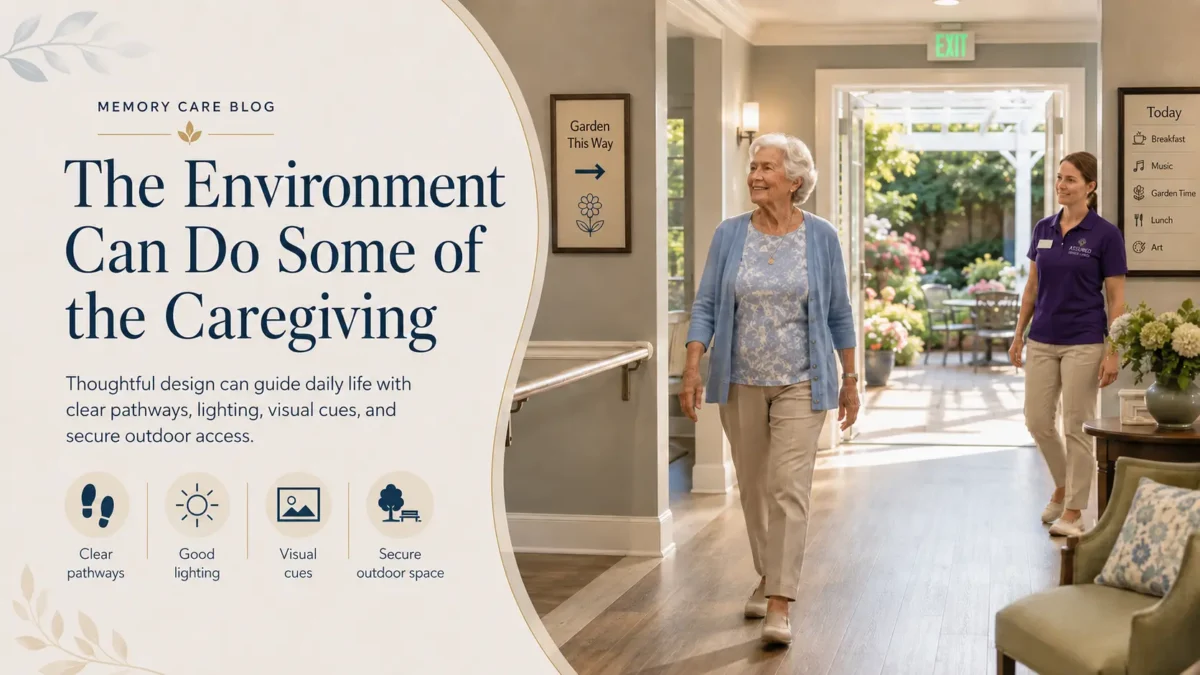
The Environment Can Do Some of the Caregiving
The physical design of memory care can either support independence or create additional confusion.
Simple changes can make daily activities easier.
Clear pathways may encourage walking.
Good lighting may make spaces easier to understand.
Contrasting colors can help certain objects stand out.
Signs or visual cues can help residents locate important areas.
An enclosed backyard may allow someone to enjoy fresh air without encountering traffic or becoming lost.
Memory care communities in Littleton and elsewhere commonly emphasize secure environments, specialized staff, 24-hour supervision, and programs designed around the needs of people living with dementia.
Thoughtful design means residents do not always need someone telling them where to go or what to do.
The environment itself provides guidance.
Personalized Assistance Should Preserve Ability
One of the easiest mistakes in caregiving is doing too much.
When a caregiver is busy, it may be faster to dress a resident completely rather than helping the resident participate.
But speed is not always the goal.
If a resident can button part of a shirt, brush their own hair, wash their face, feed themselves, or choose their clothing, those abilities should be encouraged whenever safely possible.
A caregiver might lay out two outfits rather than asking an overwhelming open-ended question.
They might place a toothbrush in someone’s hand rather than immediately brushing the person’s teeth for them.
They might begin a familiar task and allow the resident to continue.
This approach takes patience.
But the goal of quality dementia care is not simply to complete tasks.
It is to support the person completing them.
Meaningful Activity Is Part of Independence
Independence also includes having a purpose.
Older adults living with memory loss may not remember an activity tomorrow, but they can still experience enjoyment, connection, accomplishment, and belonging today.
Meaningful activities may include:
- Gardening
- Baking
- Listening to music
- Singing
- Folding laundry
- Setting a table
- Walking
- Looking through photographs
- Painting
- Pet visits
- Chair exercises
- Sorting objects
- Helping prepare food
- Simple household tasks
Activities should match the resident’s interests and current abilities.
A former gardener may enjoy watering plants.
A retired teacher might enjoy reading with someone.
A parent who spent decades cooking for the family may enjoy stirring ingredients or helping prepare a meal.
The goal does not have to be completion.
The goal can be participation.
Dignity Must Remain Part of Safety
Safety can sometimes become an excuse to remove every possible risk.
But eliminating every risk would also eliminate much of normal life.
Walking involves some risk.
Cooking involves risk.
Going outdoors involves risk.
Choosing what to eat involves risk.
The better question is not:
“How do we eliminate every risk?”
It is:
“How do we reduce unnecessary risk while preserving the person’s quality of life?”
That concept is sometimes called supported or positive risk-taking.
Families should look for caregivers who understand the difference between something being genuinely dangerous and something simply requiring supervision.
What Families Should Look For During a Memory Care Tour
When touring memory care programs, pay attention to more than the building.
Ask the tough questions and make comparisons to residential memory.
Watch what happens between caregivers and residents.
Do caregivers know residents by name?
Do they speak directly to residents rather than talking about them?
Are people encouraged to participate in daily life?
Can residents safely move around?
Are caregivers nearby?
Do residents appear rushed from one scheduled activity to another?
Are outdoor areas accessible?
How does the community respond when someone becomes anxious or confused?
Ask what happens when a resident’s abilities change.
A strong program should be able to explain how care evolves without automatically removing every choice from the resident.
Safety and Independence Are Not Opposites
Families sometimes feel they must choose between safety and independence.
The strongest residential memory care environments demonstrate that the two can support one another.
Thoughtful design can make movement safer.
Consistent caregivers can make greater freedom possible.
Personalized routines can reduce confusion.
Proper assistance can help residents continue using existing abilities.
Meaningful activities can preserve purpose.
And attentive caregivers can step in when help is actually needed rather than controlling every moment of the day.
For adult children, the goal should not simply be finding a place where a parent cannot get hurt.
The goal is finding a place where your parent can continue living.
That means being protected without being unnecessarily restricted.
Supported without being controlled.
Helped without having every task taken away.
And cared for as a person rather than managed as a diagnosis.
At Assured Senior Living, our residential memory care model is built around small-home environments, caregiver proximity, familiar routines, meaningful engagement, and relationship-based care. We believe safety matters deeply—but safety should make it possible for residents to experience more of life, not less.
If you are exploring memory care for a parent or loved one in Colorado, schedule a conversation or tour with Assured Senior Living. See how a smaller residential setting can support safety, dignity, choice, and meaningful daily life.