
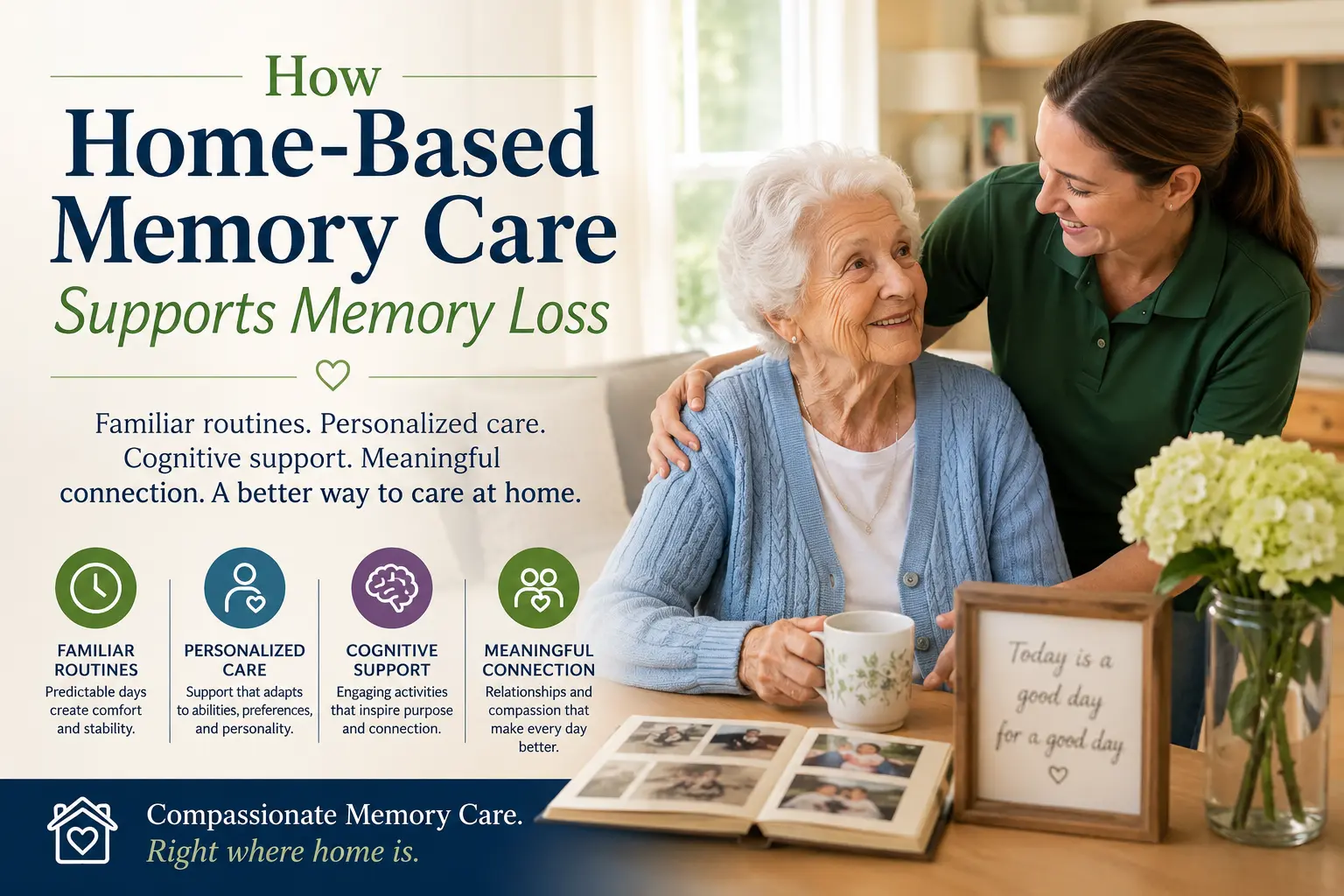
How Home-Based Memory Care Supports Memory Loss
When an aging parent begins experiencing memory loss, families often focus first on safety. Will Mom remember to take her medications? Will Dad know where he is when he wakes up? What happens if confusion increases at night? Who will notice subtle changes in behavior, appetite, mobility, or mood?
These are important questions, but effective memory loss care involves more than preventing emergencies. It should also help a person feel secure, capable, connected, and comfortable throughout everyday life.
That is where home-based memory care can offer an important alternative to a larger institutional setting.
Home-based memory care provides dementia support within a smaller, residential environment designed to feel more like everyday home life. Instead of expecting the person with memory loss to adapt to a complicated environment, caregivers can organize the environment, routines, and assistance around the individual.
For many older adults, that combination of familiarity, consistency, personalized support, and cognitive care can create greater stability as memory changes.
Why Familiarity Matters When Memory Changes
Memory loss can make ordinary situations increasingly difficult to interpret.
A person may forget where the bathroom is, become uncertain about what happens next in the day, struggle to recognize people, or become overwhelmed by noise and activity.
A highly stimulating environment with long hallways, multiple dining rooms, changing caregivers, elevators, and large groups of residents may require a person with dementia to process more information than they comfortably can.
Home-based environments can simplify daily life.
There may be a familiar kitchen, living room, dining table, backyard, bedroom, and fewer people moving throughout the home. Over time, these spaces may become recognizable through repetition even when a resident cannot always explain where they are.
Research and dementia-care resources consistently emphasize the importance of structured, familiar routines for people living with dementia. Bringing support into ordinary daily activities can help create predictability and reduce uncertainty.
The goal is not simply to create a building that looks residential.
The goal is to make daily life easier to understand.
Daily Routines Can Create Stability
Most of us depend on routines without realizing it.
We wake up, make coffee, get dressed, eat meals, walk the dog, watch a favorite television program, or go to bed at approximately the same time.
For someone experiencing memory loss, those patterns can become even more important.
A predictable morning might include waking gradually, using the bathroom, getting dressed, eating breakfast at the kitchen table, taking medications, and participating in a familiar activity.
The person may not remember what happened yesterday or understand what is planned for tomorrow. But the rhythm of the day can still feel recognizable.
Meaningful routines are frequently incorporated into memory care because they can support comfort, participation, and quality of life.
Effective home-based memory care does not mean following a rigid schedule regardless of the resident’s needs. Instead, caregivers can develop consistent patterns while remaining flexible.
If someone has spent a lifetime sleeping late, forcing that person to wake at 6:30 every morning simply because it is convenient for the care provider may create unnecessary frustration.
Good dementia care asks a different question:
How can care fit the person rather than forcing the person to fit the care?
Personalized Support Helps Preserve Independence

Someone who struggles to prepare a meal may still enjoy stirring ingredients.
A resident who cannot independently manage laundry may still find satisfaction in folding towels.
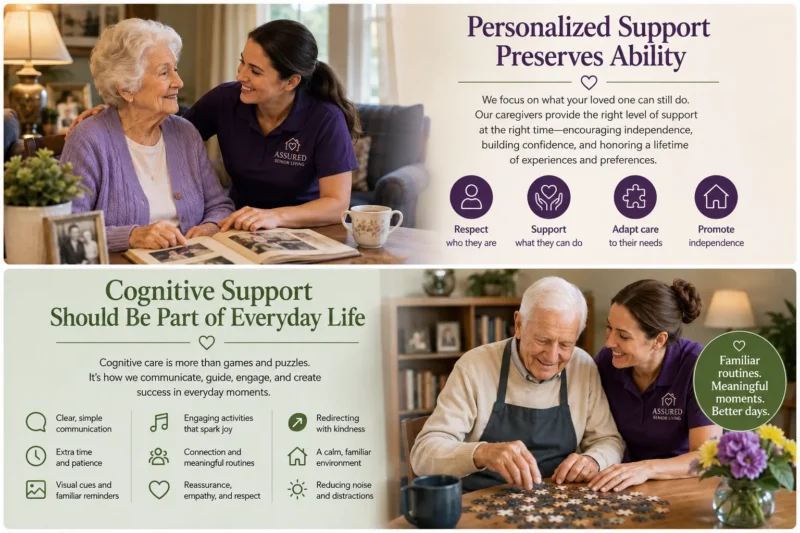
Personalized dementia support services begin by understanding what a person can still do rather than focusing only on what has been lost.
Support can then be adjusted accordingly.
One resident may need a verbal reminder to brush their teeth. Another may benefit from having the toothbrush placed in their hand. Someone else may require hands-on assistance.
Personalized support, broadly, means adapting assistance to an individual’s needs, personality, abilities, preferences, and expectations rather than applying the same approach to everyone. A big key is the adaptability of the support.
That distinction matters.
When caregivers automatically perform every task for someone, they may unintentionally remove opportunities for independence.
When caregivers provide too little assistance, the person may become frustrated or unsafe.
The best support often exists somewhere in between: helping enough for the individual to succeed while allowing them to participate as much as possible.
Knowing the Person Can Improve Memory Loss Care
A care plan may tell caregivers that someone needs assistance with bathing or medications.
It may not tell them that she was a schoolteacher for 35 years, loves gardening, dislikes being rushed in the morning, prefers coffee with cream, becomes anxious around loud voices, or spent every evening listening to jazz with her husband.
Those details matter.
Personalized care becomes more effective when caregivers understand the person behind the diagnosis.
In a smaller home-based setting, residents may interact with a more consistent group of caregivers. That continuity can give caregivers opportunities to recognize patterns.
They may learn that pacing usually means the resident needs the bathroom.
They may recognize that refusing breakfast means the person has not fully awakened yet.
They may understand that asking repeatedly to “go home” increases late in the afternoon and that looking at family photographs or taking a short walk helps provide reassurance.
This type of knowledge can turn caregiving from task completion into relationship-based support.
Cognitive Care Happens Throughout the Day
Families sometimes hear the words cognitive care and picture memory games, puzzles, or trivia.
Those activities can be useful when someone enjoys them, but cognitive support is much broader.
It includes how caregivers communicate.
A caregiver might use one clear instruction rather than giving several directions simultaneously.
It includes how choices are presented.
Instead of asking, “What would you like to wear today?” a caregiver might show two shirts and ask, “Would you like the blue shirt or the green one?”
It includes reducing unnecessary distractions, allowing extra time to respond, providing visual cues, redirecting rather than arguing, and acknowledging emotion even when the caregiver does not agree with the resident’s version of events.
Meaningful cognitive engagement can also come from ordinary activities.
Gardening, baking, listening to music, walking, folding laundry, looking through photographs, simple art, setting a table, or talking about past occupations can engage memory, movement, language, and emotion without making the person feel tested.
A systematic review of home care for older adults with dementia highlights the range of interventions that are delivered in community and home environments to support people living with dementia.
The goal is not to quiz someone into remembering.
The goal is to create successful moments of participation.
A Smaller Environment Can Make Care More Responsive
One potential assisted living benefit of a smaller residential model is caregiver proximity.
In a large community, a caregiver may need to travel between floors, hallways, wings, or apartments.
In a home-based setting, caregivers and residents often share the same common areas throughout much of the day.
That proximity may make it easier to notice small changes.
Perhaps a resident is eating less.
Maybe they are walking differently.
They seem unusually tired.
They are visiting the bathroom more frequently.
They suddenly stop participating in an activity they normally enjoy.
None of these changes automatically means something is medically wrong, but early observation allows families and clinical professionals to investigate when appropriate.
For adults making care decisions for a parent, it is worth asking not simply how many employees work at a community but how close caregivers are to residents throughout the day and night.
Senior Care at Home Should Support Emotional Safety Too
Physical safety matters, but emotional safety is equally important in dementia care.
Imagine repeatedly waking up and not recognizing where you are.
Imagine someone correcting you every time you misunderstand something.
Imagine needing help with bathing or dressing from people you do not recognize.
Memory loss can make the world feel unpredictable.
Caregivers cannot eliminate dementia, but they can influence how the person experiences each moment.
A familiar and calm voice matters.
A trusted face with a warm smile matters.
Familiar routines matter.
Being greeted by name matters.
Having preferences remembered matters.
Being offered reassurance instead of correction matters.
Receiving help without being rushed matters.
These seemingly small interactions can shape whether senior care at home feels supportive or simply supervisory.
Family Communication Remains an Important Part of Care
Adult children often become an essential source of information as memory loss progresses.
Families can explain lifelong routines, preferences, fears, meaningful relationships, favorite foods, music, hobbies, former careers, and important personal history.
Professional in-home care resources similarly encourage families to evaluate the specific type of assistance a person needs and carefully consider care options as dementia progresses.
Communication should continue after a resident moves into care.
Families should understand how their parent is eating, sleeping, participating, moving, and responding emotionally.
They should also know when meaningful changes occur.
Home-based memory care works best when families and caregivers see one another as partners rather than separate parts of the care process.
What Families Should Look for in Home-Based Memory Care
When comparing memory care options, look beyond the appearance of the home.
Ask how care actually works.
Consider asking:
- How consistent are the caregivers?
- What happens when a resident becomes confused or anxious?
- How are individual routines incorporated into the day?
- How does the team determine what a resident can still do independently?
- What cognitive and meaningful activities are available?
- How are changes in behavior, appetite, sleep, or mobility communicated?
- Who is available overnight?
- How does the home respond when a resident’s needs increase?
- How are families involved in updating the care plan?
- Does the environment feel calm, comfortable, and genuinely familiar?
Do not evaluate memory care only by counting amenities.
Evaluate how well the environment helps your parent navigate everyday life.
The Goal Is Not Simply More Care—It Is Better-Matched Care
Memory loss changes how a person experiences the world, but it does not erase personality, preferences, relationships, dignity, or the need to feel useful.
Effective home-based memory care recognizes that reality.
Through familiar daily routines, personalized assistance, consistent relationships, meaningful engagement, and thoughtful cognitive care, a smaller residential environment can help make everyday life more understandable and manageable.
For adult children, choosing memory care should therefore involve more than asking where a parent can be supervised.
Ask whether they will truly be known and loved.
Ask where caregivers will understand their routines.
Ask where assistance can change as abilities change.
And most importantly, ask where your parent is most likely to feel safe, comfortable, respected, and at home.
Because when memory becomes less reliable, familiarity and human connection can become some of the most important forms of support.
Find Memory Care That Feels Like Home
Choosing memory care for a parent is about more than finding a safe place to live. It is about finding an environment where they can be known, understood, supported, and treated with dignity every day.
At Assured Senior Living, our small-home memory care model is designed around familiar routines, consistent caregivers, personalized support, meaningful engagement, and close caregiver proximity. We focus on creating a true residential environment where seniors with memory loss can feel comfortable, connected, and at home.
If you are exploring home-based memory care for a parent or loved one in Colorado, we invite you to see the difference a smaller, relationship-based setting can make.
Schedule a conversation or tour with Assured Senior Living today to learn more about our memory care homes, meet our team, and discover whether our approach is the right fit for your family.
Assured Senior Living — Love, it’s what we do.