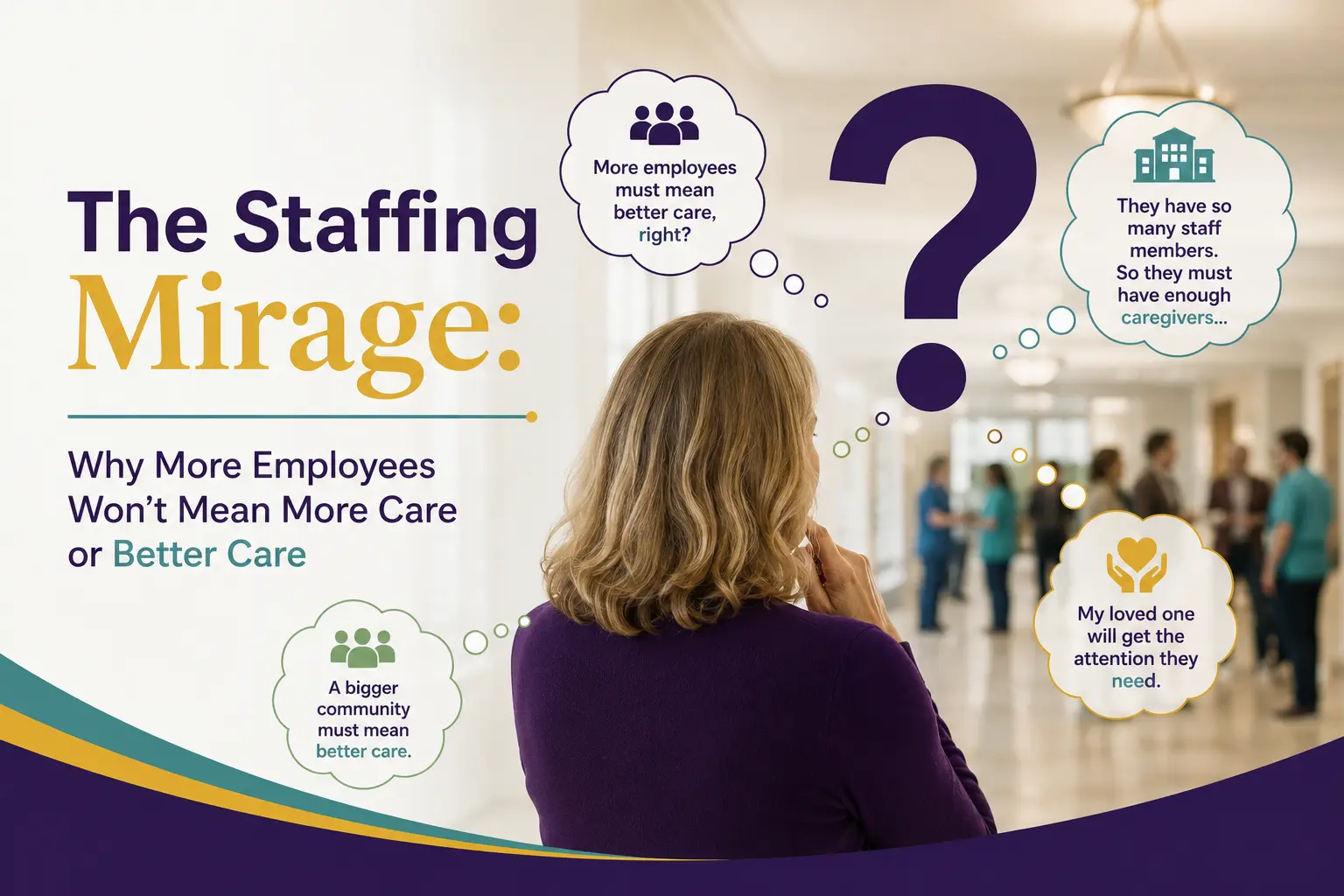
The Staffing Mirage: Why More Employees Won’t Mean More Care or Better Care
When families begin the search for senior living, they often assume that larger communities provide better care simply because they employ more people.
That makes sense.
You walk into a large senior living community and immediately see activity everywhere. Receptionists greet visitors at the front desk. Executive directors and department managers move through the hallways. Sales counselors conduct tours. Activities directors are planning events. Dining teams are serving meals. Housekeepers are cleaning rooms. Maintenance staff are caring for the building. Nurses are making rounds.
So the community appears busy, vibrant, and heavily staffed.
For many families, that first impression builds confidence. More employees must mean more care, right?
But not necessarily.
In fact, one of the biggest misconceptions in senior living is confusing the total number of employees with the number of direct caregivers actually available to provide resident care during a shift.
And that difference is enormous.
And understanding that difference may be one of the most important factors in choosing the right home for a loved one.
The Question Most Families Never Ask
During a tour, families often ask questions like:
- What activities do you offer?
- How often is housekeeping provided?
- What are your dining options?
- What is included in the monthly rate?
- Do you have transportation services?
Those are all reasonable questions.
But there is one question that is far more important than almost any other:
“How many caregivers are actually available to help my loved one right now?”
Not the total employees.
Not the total staff.
Not the number of people working in the building.
The number of direct caregivers responsible for resident care during each shift.
Because when Mom needs help getting to the bathroom, when Dad is anxious and confused, or when a resident with dementia wakes up frightened in the middle of the night, the person who matters most isn’t the executive director or the marketing director.
It’s the caregiver.
The Difference Between Staffing and Caregiving
Many large senior living communities employ dozens—or even hundreds—of people.
On paper, that can sound impressive.
However, many of those positions do not provide direct resident care.
A typical community may include:
- Executive leadership
- Human resources
- Sales and marketing
- Reception
- Dining services
- Maintenance
- Housekeeping
- Transportation
- Activities
- Nursing administration
Each of these roles serves an important purpose.
But none of them are helping Mrs. Smith get dressed this morning.
None of them is assisting Mr. Jones to the bathroom at 2:00 a.m.
None of them is sitting beside a resident experiencing anxiety related to dementia.
Direct caregivers are individuals who spend most of their day physically caring for residents.
Yet this distinction often gets lost when communities discuss staffing.
Families hear, “We have over 100 employees.”
What they should be hearing is:
“During this shift, each caregiver is responsible for this many residents.”
That is the number that truly matters.
The Reality Behind Caregiver Ratios
Across the assisted living industry, caregiver-to-resident ratios vary dramatically from shift to shift.
Industry sources commonly cite a ratio of one caregiver for every eight residents on a given shift, though staffing often fluctuates by shift, care needs, and community model.
In many larger communities, particularly during evenings, overnight hours, or staffing shortages, caregivers may be responsible for significantly more residents per shift. Post-COVID, this has become a huge trend and a big factor that many large communities try to hide.
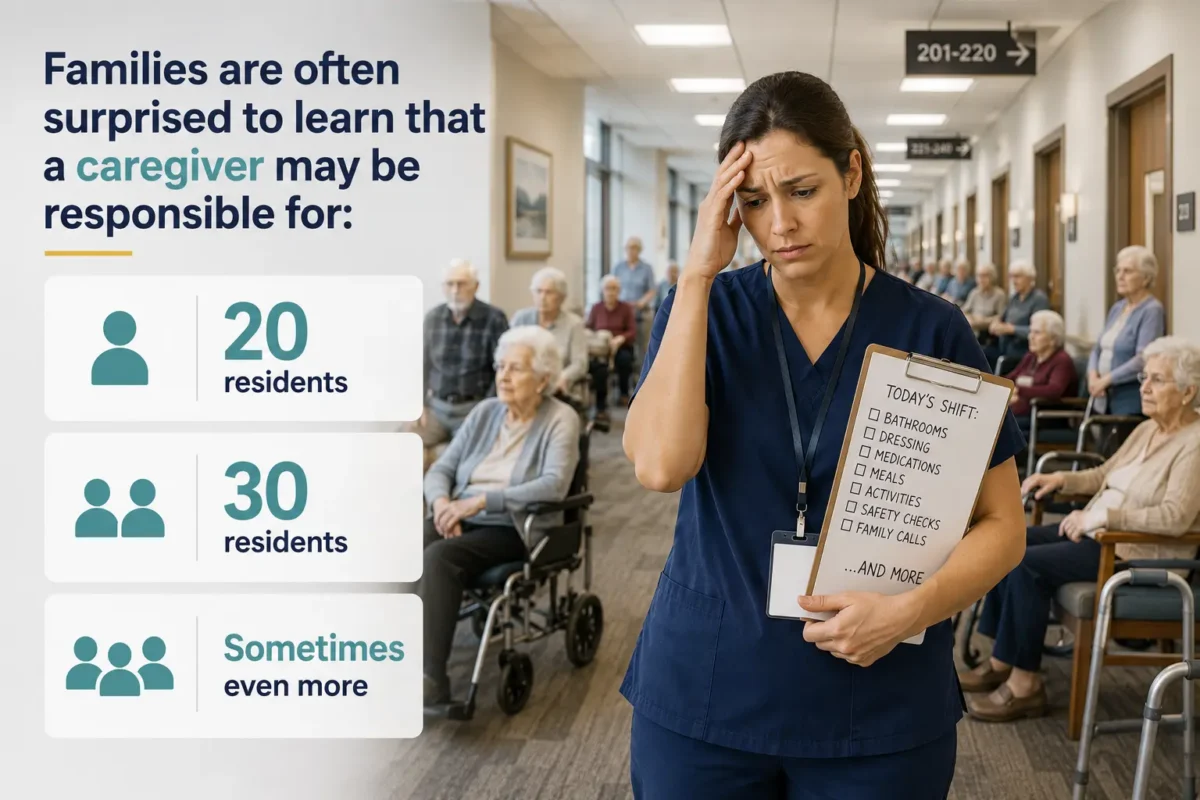
Far too often large communities misled family on staffing ratios.
Families are often surprised to learn that a caregiver may be responsible for:
- 20 residents
- 30 residents
- Sometimes even more
during many portions of the day.
Think about that for a moment:
Imagine being responsible for helping 25 people:
- Wake up
- Get dressed
- Use the restroom
- Take medications
- Move safely throughout the building.
- Attend meals
- Manage anxiety
- Prevent falls
- Address emergencies
all within the same shift.
Even the most dedicated caregiver can be in only one place at a time.
The issue isn’t whether caregivers care enough.
The issue is not whether caregivers care enough.
The Greatest Luxury in Senior Living Is Time
The senior living industry often markets luxury through amenities.
Beautiful lobbies.
Elegant dining rooms.
Movie theaters.
Fitness centers.
Coffee bars.
Walking paths.
And while those features can certainly enhance quality of life, they do not necessarily improve care.
Because when a resident is scared, confused, lonely, or physically struggling, the most valuable resource isn’t a grand building.
It’s time.
Time for a caregiver to sit and listen.
Time to provide reassurance.
Time to notice subtle changes in health.
Time to redirect someone living with dementia.
Time to learn a resident’s preferences and routines.
Time to build trust.
Care cannot be rushed.
Relationships cannot be rushed.
Human connection cannot be rushed.
Yet staffing models often determine whether caregivers have enough time to provide these things.
The Small Home Difference
At Assured Senior Living, many homes operate with two caregivers serving eight residents.
That is a fundamentally different care model.
That means caregivers aren’t responsible for an entire hallway or multiple wings of a building.
They are responsible for a small group of people they know deeply.
Over time, caregivers learn things that never appear on an assessment form. They are proactive in their care, not reactive.
They know:
- Favorite meals
- Preferred morning routines
- Sleep patterns
- Family stories
- Reasons for anxiety
- Personal habits
- Individual preferences
- Proactive with behaviors
They know who likes coffee before breakfast.
They know who prefers quiet in the morning.
They know who becomes anxious during sundowning.
They know who needs a gentle reminder and who needs hands-on assistance.
That level of familiarity isn’t created through training manuals.
It’s created through proximity.
Staffing Proximity Changes Everything
The real difference isn’t the quantity of staff.
It’s staffing proximity.
When caregivers are consistently present, they begin noticing things before they become problems.
They notice:
- Reduced appetite
- Changes in mobility
- Increased confusion
- Mood changes
- Changes in overall conditions
- Sleep disturbances
- Early signs of illness
These small observations often prevent larger issues.
A caregiver who sees the same resident every day develops an understanding that cannot be replicated through charting systems or shift reports.
This is particularly important for individuals living with dementia.
Residents with memory loss (cognitive impairment) often rely on familiarity and routine to feel secure.
Seeing the same faces.
Hearing the same voices.
Following the same daily rhythms.
Together, these experiences create emotional stability.
When caregivers have time to develop relationships, residents feel safer.
And when residents feel safer, the quality of life improves.
What Happens at 2 A.M.?
One of the most important questions families can ask is rarely discussed during tours.
“What happens at 2 a.m.?”
Most tours occur during the busiest and most polished part of the day.
Activities are happening.
Managers are present.
Dining services are operating.
So everything looks wonderful.
But care doesn’t stop when the tour ends.
Care continues overnight.
What happens when:
- A resident falls
- Someone becomes disoriented
- A bathroom assist is needed.
- A resident wakes up frightened.
- Medical concerns arise
How many caregivers are awake?
How many residents are assigned to each caregiver?
How quickly can they respond?
The answers to those questions often reveal far more about a community’s care model than anything visible during a daytime tour.
Why Families Deserve Transparency
Families are making one of the most emotional and important decisions of their lives.
They deserve transparency and clarity.
Not marketing language.
Not broad staffing claims.
Not vague assurances.
They deserve clear answers.
They deserve to know exactly how care is delivered.
Staffing ratios are not merely operational statistics; they have a significant impact.
They directly influence:
- Response times, aka “call buttons”
- Resident safety
- Fall prevention
- Emotional well-being
- Care consistency
- Family satisfaction
- Quality of life
- Purpose filled days
Every community should be willing to discuss these numbers openly.
And every family should feel empowered to ask.
The Question That Changes Everything
When evaluating senior living communities, ask every community this question:
“What is the actual caregiver-to-resident ratio on every shift?”
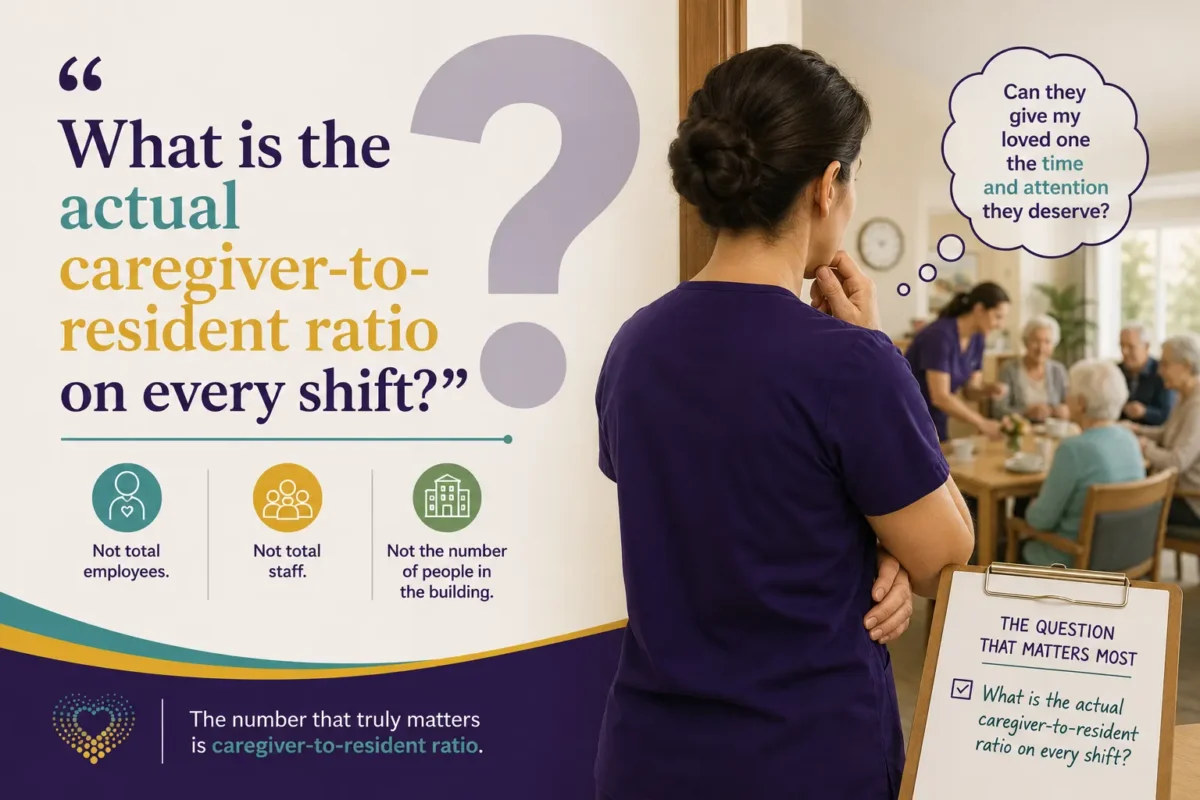
Not total employees but what is the actual caregiver to resident ratio?
Ask about mornings and individualized routines.
Ask about evenings and the ability for a resident to slow down.
Ask about overnight staffing and if they are awake.
Ask specifically about direct caregivers.
The answer will tell you more about the resident experience than almost any brochure, website, or sales presentation ever could.
Because at the end of the day, quality care is not measured by the size of a building.
It is not measured by the number of employees on payroll.
It is not measured by how impressive a lobby looks.
Quality care is measured by whether a caregiver has the time, presence, and ability to truly know the person they are caring for.
The greatest predictor of care is not staffing quantity.
It’s staffing proximity.
And when caregivers have the time to build meaningful relationships, residents don’t just receive care.
They experience dignity, connection, and a true sense of home.
At Assured Senior Living, we strive to create that difference every day.
To the see the true difference in how our staffing changes the lives of our residents everyday reach out to one of our amazing team members.