Choosing care for a parent is rarely simple. Families must consider safety, cost, location, medical needs, and quality of life—often while responding to a sudden change in their loved one’s health.
One of the most important decisions is whether a small residential setting or a larger senior living campus will provide the right support. This comparison centers on a key question: not which option looks most impressive during a tour, but which environment will know your parent the best, respond consistently, and adapt as their needs change. This article argues that the better choice is the one that provides the right mix of consistency, responsiveness, and long-term fit.
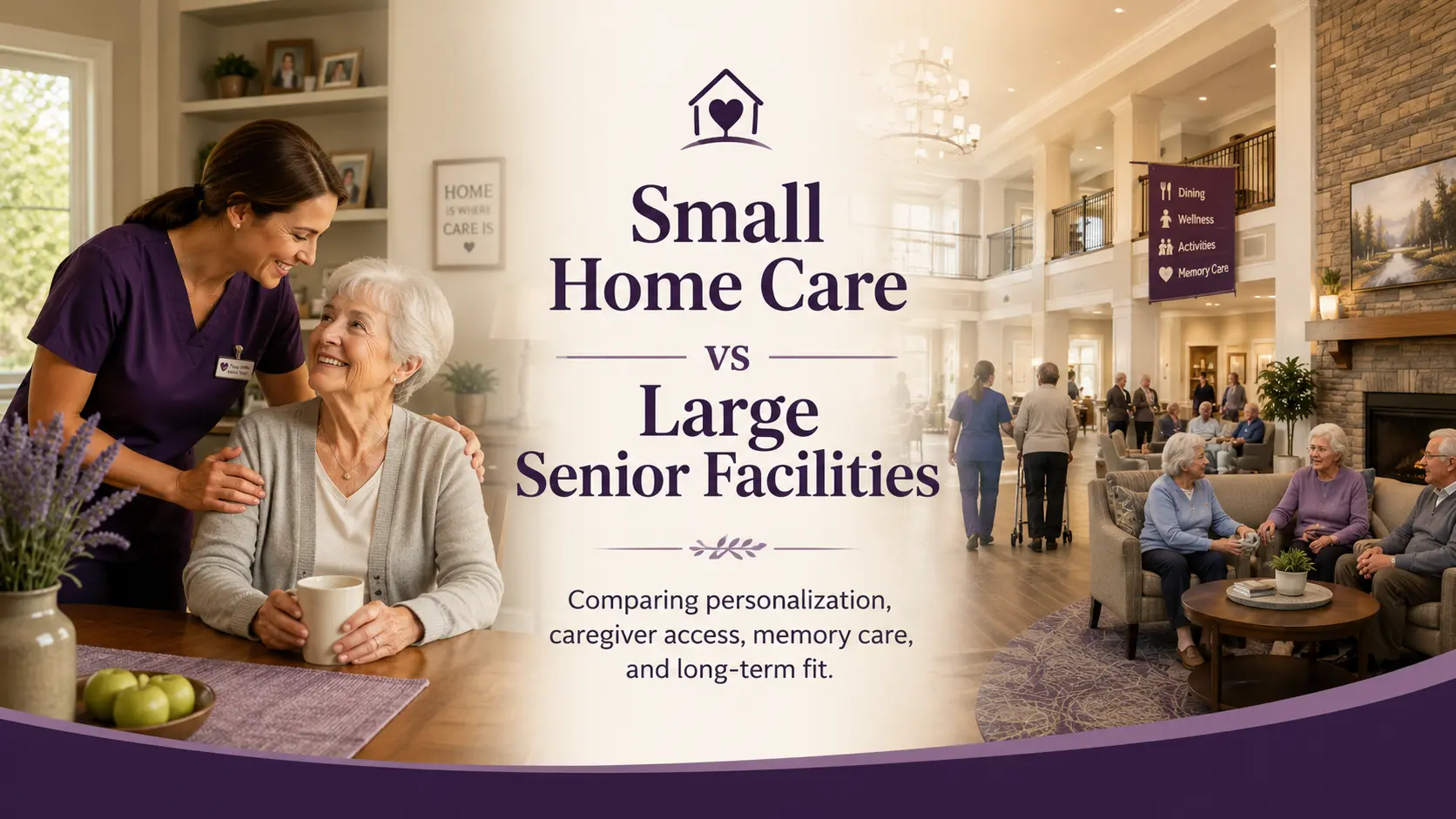
This senior living comparison examines home-based assisted living and larger senior care facilities through personalization, caregiver access, memory care, support for traumatic brain injury, and long-term fit. It shows how the right setting depends on whether the resident needs a more personal daily rhythm or broader amenities and services.
What Is Home-Based Assisted Living?
Home-based assisted living is a small residential care setting that provides daily support in a house-like environment. It differs from traditional home care services, where a caregiver travels to an older adult’s private residence for scheduled visits.
In home-based assisted living, residents move into the care home and have access to caregivers throughout the day and night. Support may include:
- Medication management
- Bathing and dressing assistance
- Mobility support
- Meals and snacks
- Housekeeping and laundry
- Activities and companionship
- Safety monitoring
These homes usually serve fewer residents than large communities. Shared meals, familiar living spaces, and smaller caregiver teams can create a more personal daily rhythm. By contrast, larger communities may provide more amenities and on-site departments, which can help guide the decision.
How Large Senior Facilities Differ
Large senior facilities may serve dozens or even hundreds of residents. Many have multiple dining venues, activity rooms, fitness centers, salons, transportation programs, theaters, and specialized care wings.
Families may appreciate this variety, especially when a parent is socially active and enjoys choosing from a full calendar of events.
The potential tradeoff is scale.
More residents, departments, and employees can complicate care delivery. Support may be organized around staff shifts, unit assignments, and community-wide schedules. Residents may interact with several caregivers during a single day.
That does not automatically mean the care will be impersonal. Many large senior care facilities have experienced and compassionate teams. Still, families should ask how individual preferences are protected inside a much larger operating system.
Personalization and Daily Experience
Personalization is one of the clearest differences between home-based assisted living and a large facility, and it should guide the decision.
In a small home, caregivers may quickly learn:
- How a resident likes their coffee
- When they prefer to wake up
- Which foods they enjoy
- What music helps them relax
- How they communicate pain or discomfort
- Which routines reduce anxiety
Because fewer people live in the home, daily schedules may be easier to adjust to each resident, supporting a more flexible routine.
v
In a larger facility, personalization depends heavily on staff consistency, communication, and operational flexibility. A resident may have access to more activities but may also interact with more employees, so families should weigh activity variety against the need for familiar caregivers and predictable routines.
Families should ask whether the resident’s care plan shapes their actual daily routine or primarily exists inside an electronic record.
The most important question is not simply, “What services do you offer?”
It is, “How will you learn who my parent is?”
Caregiver Access and Responsiveness
A large employee count does not necessarily mean a resident receives more direct attention, so families should look beyond staffing size alone.
Ask how many caregivers are assigned to your parent’s neighborhood, how many residents each caregiver supports, and whether staffing levels change overnight or on weekends. These details help families assess responsiveness and consistency, and determine whether the setting can meet daily care needs.
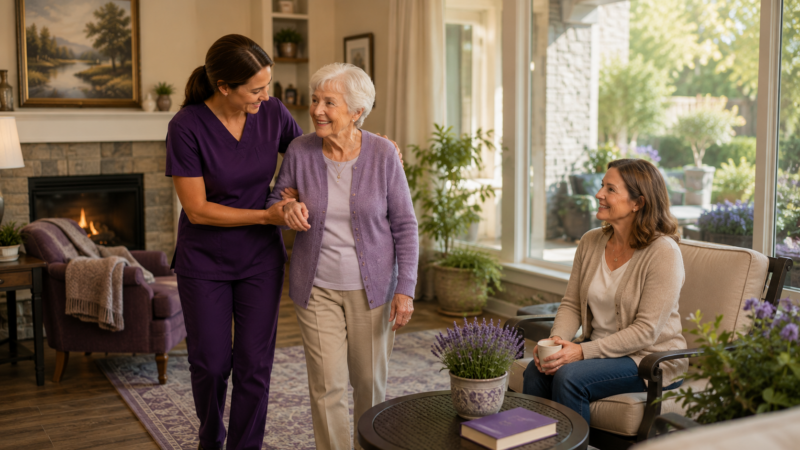
Home-based assisted living may provide easier access for caregivers because employees work in a smaller physical environment and generally support fewer people. Caregivers may be more likely to notice a change in appetite, balance, sleep, mobility, or mood before the resident asks for assistance.
Large senior facilities often use call buttons, emergency pendants, and formal response systems. These tools can be valuable, but families should ask about average response times and whether caregivers provide proactive observation.
The goal should not merely be responding after something goes wrong. The care team should know the resident well enough to recognize concerns early and act on them.
Memory Care in Small and Large Settings
Memory care is specialized residential care for people living with Alzheimer’s disease, dementia, or another form of cognitive impairment. It commonly includes structured routines, environmental safeguards, supervision, and caregivers trained to respond to memory-related needs.
For someone living with dementia, familiarity and consistency can be clinically meaningful. Regular caregivers may recognize subtle signs of pain, infection, fear, fatigue, or overstimulation.
A smaller setting may also reduce:
- Excessive noise
- Long hallways
- Unfamiliar faces
- Crowded common areas
- Frequent room-to-room transitions
Large memory care communities may offer secure outdoor courtyards, dedicated activity teams, sensory programs, and multiple levels of group engagement. Someone who enjoys frequent social activity and is comfortable in a busier.
Families should look beyond the words “memory care” and ask:
- How often do caregivers rotate?
- How long have caregivers been here?
- What dementia-specific training is required?
- How are distress, wandering, or resistance to care handled?
- Are routines adapted to each resident?
- What happens when care needs increase?
TBI and Brain Injury Support
Traumatic brain injury support requires more than general assistance with daily living.
A person with a TBI or acquired brain injury may experience changes in memory, judgment, communication, mobility, impulse control, emotional regulation, and executive functioning.
A smaller residential home may provide a calmer setting with fewer environmental triggers. Consistent caregivers can learn how the person communicates, which situations cause frustration, and what strategies encourage independence, making the setting a better fit when familiarity and predictability matter most.
This familiarity can be especially valuable when behavioral support depends on trust, repetition, and predictable routines.
Larger facilities may offer easier access to nursing, therapy services, rehabilitation providers, or specialized equipment. Even so, not every assisted living community is prepared to support complex brain injury needs.
Families should ask whether the provider has direct experience with:
- TBI and acquired brain injury
- Behavioral support plans
- Mobility and transfer assistance
- Medication management
- Emotional regulation strategies
- Therapy and case-manager coordination
The label “assisted living” does not automatically guarantee specialized expertise in brain injury.

Assisted Living vs Nursing Home Care
The phrase “assisted living vs. nursing home” often creates confusion.
Assisted living generally supports people who need help with bathing, dressing, medications, meals, mobility, or supervision but do not require continuous skilled nursing care.
A nursing home provides a higher level of medical support. Services may include 24-hour nursing oversight, rehabilitation, wound care, complex medication administration, and treatment for serious health conditions.
Both small and large communities may provide assisted living. Neither should claim to replace skilled nursing when a resident’s medical needs exceed the provider’s license or capabilities, so families should ask what conditions the community can manage, what changes would trigger a transfer, and how the provider supports families during care transitions.
Ask what conditions the community can manage, what changes would trigger a transfer, and how the provider supports families during care transitions.
Home Care Services vs Residential Care
Home care services allow an older adult to remain in their own residence while caregivers visit for scheduled support. The primary difference between assisted living and home care is the setting, although staffing, supervision, cost, and family involvement also differ.
Home care may work well when needs are predictable and limited. As those needs increase, families may need to coordinate:
- Multiple caregiver visits
- Overnight supervision
- Medication oversight
- Transportation
- Meals and groceries
- Home modifications
- Emergency planning
Home-based assisted living can bridge the gap between living alone with visiting support and moving into a large senior campus. It combines a residential environment with continuous oversight while preserving many of the comforts of home.
How to Choose the Right Elderly Care Option
There is no single best choice for every family.
Home-based assisted living may be a good fit for someone who benefits from a quiet setting, flexible routines, close observation, familiar caregivers, and support for dementia or TBI. In this comparison, that profile best matches the setting that knows the person well and adapts more easily to daily needs.
A larger facility may be a better fit for someone who prefers extensive amenities, numerous activities, multiple dining options, a larger peer community, and on-site therapy or clinical resources. Families should choose it when variety and available services outweigh the need for a smaller, more familiar environment. In this comparison, that profile best suits a resident who values breadth of services over close daily consistency.
During tours, look beyond the model room. Watch how caregivers speak to residents. Ask how long direct-care employees have worked there. Learn who provides care at night and on weekends.
Most importantly, request real examples of how the community has adapted when a resident’s needs changed, so you can judge whether the setting will continue to fit over time.
The Best Setting Is the One That Knows the Person
A beautiful building can make a powerful first impression. Yet daily quality of life often depends on much smaller moments:
A caregiver noticing an unspoken need.
A familiar face reducing anxiety.
A meal prepared around a personal preference.
A daily routine that protects dignity and independence.
The most meaningful senior living comparison is not simply small versus large. It is personal versus standardized, proactive versus reactive, and capable versus unprepared, so families can decide which environment best matches their parent’s current and changing needs. The best setting is the one that knows the person and consistently meets their needs over time.
Choose the environment where your parent will be known, supported, and treated as an individual. Whether that is home-based assisted living or a larger community, the right choice should provide more than a place to live.
It should provide safety, connection, and confidence that care will remain personal as your loved one’s needs evolve.
Discover the Difference Personalized Care Can Make
Your loved one deserves more than a room in a large facility. They deserve a home where caregivers know their routines, recognize subtle changes, honor their preferences, and provide support with dignity, patience, and genuine connection.
At Assured Senior Living, our small-home communities provide personalized assisted living, memory care, and specialized brain injury support in comfortable residential settings. We invite you to experience the difference between simply receiving care and truly being known.
Do not wait for a crisis to decide what comes next. Contact Assured Senior Living today to speak with a knowledgeable care advisor, schedule a personal tour, and discover whether our home-based assisted living model is the right choice for your family.