Board and Care vs Assisted Living for Families
Choosing care for an aging parent is rarely simple. Families may compare price, location, room size, and amenities, but the question that often matters most is more personal: Where will my loved one feel known, supported, and safe?
Two common senior living options are a Board and Care Home and a larger assisted living community. Both may provide meals, medication support, housekeeping, supervision, and help with daily activities. However, the experience can differ greatly depending on the setting’s size, caregiver availability, routines, and family communication.
Understanding those differences can help adult children look beyond brochures and choose an environment that supports comfort, dignity, and quality of life.
What Is a Board and Care Home?
A Board and Care Home is a smaller residential setting where a limited number of older adults live together and receive assistance from caregivers. Depending on the state, these settings may also be called residential assisted living homes, adult family homes, personal care homes, or small senior care facilities.
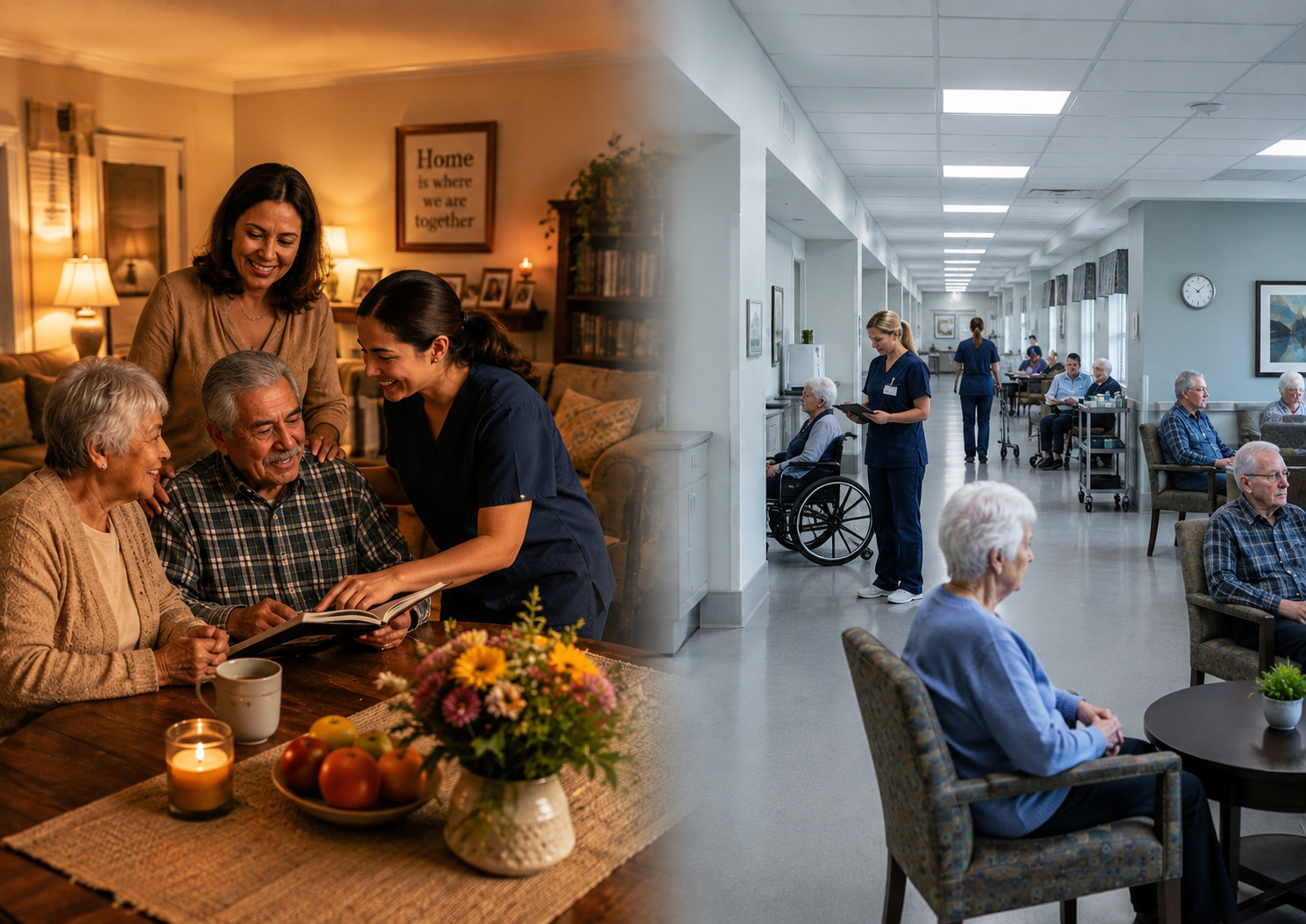
Unlike a large senior campus, a Board and Care Home usually looks and feels like a private residence. Residents may share meals around a kitchen table, relax in a familiar living room, spend time in a backyard, and follow routines that resemble everyday home life.
Care may include help with bathing, dressing, medication management, mobility, meals, toileting, laundry, safety supervision, and memory loss. The smaller environment can make it easier for caregivers to know each resident and notice changes quickly.
What Is Traditional Assisted Living?
Traditional assisted living often refers to a larger community serving dozens or even hundreds of residents. These communities may include private apartments, large dining rooms, salons, fitness areas, activity spaces, transportation, and organized social programs.
Hallways, floors, wings, and departments may organize care. Residents may interact with several caregivers across different shifts. The care can still be compassionate and professional, but it may feel more structured and less intimate than home-based senior care.
Personalized Care: Knowing More Than the Care Plan
One of the most important differences in an elderly care comparison is how deeply caregivers can learn each resident’s preferences and patterns.
In a Board and Care Home, caregivers often work with the same small group of residents. They may learn that someone wants coffee before getting dressed, becomes anxious late in the afternoon, needs extra encouragement at breakfast, or sleeps better after listening to familiar music.
Personal knowledge is especially important for residents living with dementia, Parkinson’s disease, mobility challenges, or communication difficulties. A resident may not be able to explain pain, fear, hunger, or fatigue. A familiar caregiver may recognize a problem through changes in expression, posture, appetite, sleep, or behavior.
In larger assisted living facilities, employees may support more residents or rotate among different areas. Even excellent caregivers may have less time to know each person at the same depth.
Caregiver Access and Proximity
Families often ask how many people work in a community. A better question is how many direct-care caregivers are available when help is needed.
A large facility may employ many people, but not every employee provides hands-on care.
In a smaller home, caregivers are usually physically closer. They may be in the kitchen, living room, hallway, or another bedroom instead of on a different floor or across a large campus.
A resident may not have to press a call button before receiving help. A caregiver may notice that the person is trying to stand, seems unusually confused, has not eaten, or is moving differently than usual.
This proactive attention is one potential advantage of a smaller setting. Care begins with observation rather than waiting for a request.
Daily Routines and Meaningful Engagement
Daily life in a Board and Care Home is often built around familiar household rhythms. Residents may wake at different times, eat home-cooked meals together, fold towels, water plants, watch a favorite program, sit outside, or join a small-group activity.
This can comfort people who become overwhelmed by crowds, noise, or frequent transitions.
Larger communities commonly offer extensive activity calendars, including exercise classes, games, entertainment, outings, and educational programs. For an active resident who enjoys variety and can participate independently, those choices may be a major benefit.
Families should not judge engagement by the number of events on a calendar alone. The better question is whether the resident will actually participate.
Some older adults need personal encouragement, adapted activities, or a quieter setting. A simple activity connected to personal interests may be more meaningful than a full schedule that feels confusing or inaccessible.
Family Involvement and Communication
Adult children want to know more than whether tasks are finished. They want to understand how their parent is eating, sleeping, socializing, moving, and adjusting emotionally.
In a smaller home, communication may be more direct because caregivers and leaders know the resident personally. Families may hear about changes in appetite, mood, mobility, or participation before they become larger concerns.
In a large community, communication may move through several departments, creating distance from the person providing hands-on support.
During a tour, ask who provides updates, how changes are reported, and whether families can communicate with direct-care staff.
Board and Care, Assisted Living, and Nursing Homes
Families frequently research assisted living vs nursing home care. A Board and Care Home generally falls within the broader assisted living category rather than the nursing home category.
Assisted living is designed for people who need support with daily activities but do not require continuous skilled nursing care. Nursing homes usually serve individuals with more complex medical needs, intensive rehabilitation requirements, or conditions requiring a higher level of licensed clinical oversight.
A smaller residential home or small residential assisted living may still support someone who needs significant assistance, supervision, memory care, or mobility help, provided the home is licensed, staffed, and equipped for those needs. In many cases, a small residential assisted living is better prepared to handle higher care needs because of the intimate environment.
Services vary, so families should ask about caregiver training, nursing support, medication management, emergency procedures, memory care experience, transfer assistance, and conditions that might require a future move. No matter the community- board and care, residential assisted living, big box assisted living, or nursing home always ask the true questions that matter, focusing on care and staffing ratios.
Benefits of Each Model
Larger assisted living communities may offer more apartment choices, broader social opportunities, multiple dining venues, transportation, therapy spaces, and extensive activities. They may be an excellent fit for independent and socially active older adults.
A Board and Care Home may offer a calmer environment, shorter walking distances, consistent caregivers, personalized routines, close supervision, small-group engagement, and direct family communication.
The greatest difference is often not the décor or building size. It is the amount of time, proximity, and attention caregivers can provide.
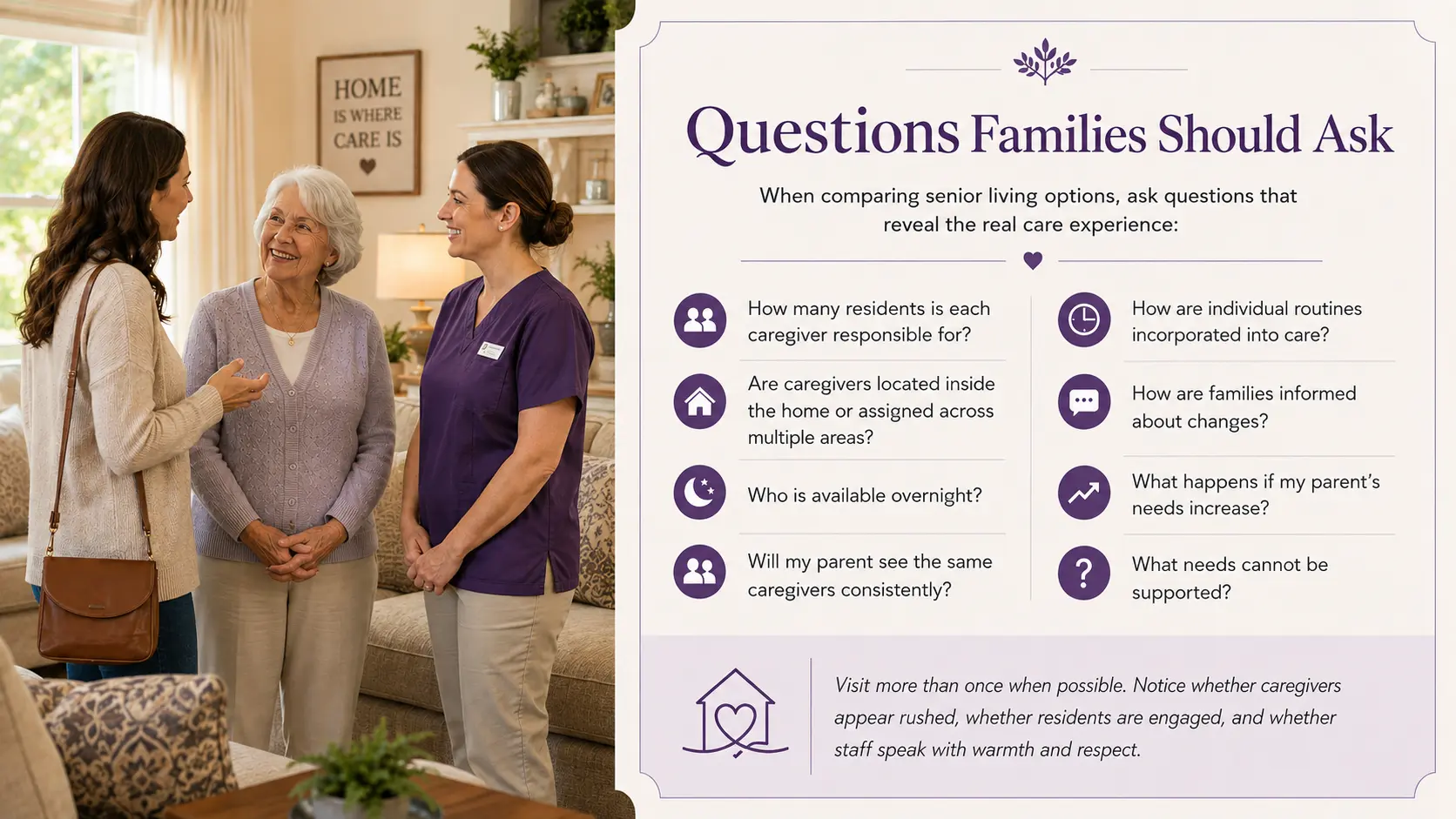
Questions Families Should Ask
When comparing senior living options, ask questions that reveal the real care experience:
- How many residents is each caregiver responsible for?
- Are caregivers located inside the home or assigned across multiple areas?
- Who is available overnight?
- Will my parent see the same caregivers consistently?
- How are individual routines incorporated into care?
- How are families informed about changes?
- What happens if my parent’s needs increase?
- What needs cannot be supported?
Visit more than once when possible. Notice whether caregivers appear rushed, whether residents are engaged, and whether staff speak with warmth and respect.
Choosing the Right Environment
There is no single model that is right for every older adult. A larger community may suit someone who values independence, amenities, and a broad social environment. A Board and Care Home may better support someone who needs familiar routines, consistent attention, a quieter setting, and caregivers who remain nearby.
The decision should not be based only on what looks impressive during a tour. Families should consider what daily life will feel like after they leave.
Will your loved one be known? Will caregivers notice small changes? Will help be nearby? Will routines reflect personal preferences? Will your family receive honest and timely communication?
At Assured Senior Living, we believe older adults deserve more than a room in a facility. They deserve a true home where caregivers know their stories, understand their routines, and provide support with dignity, patience, and love.
Our home-based senior care model is designed around personal attention, consistent caregiver access, meaningful daily routines, and close family communication in an intimate residential setting.
When care becomes personal, residents gain more than assistance. They gain connection, security, purpose, and a place where they truly belong.
To learn more, reach out to one of our expert advisors.
Love, it’s what we do.