

Denver Assisted Living With Daily Activities: Why Meaningful Days Matter
Choosing Denver home-based assisted living is about more than finding someone who can help with medications, meals, bathing, dressing, or mobility.
For many families, one question eventually becomes even more important:
What will my parent actually do all day?
It is an important question because senior living is not simply about where someone sleeps at night. It is about how that person experiences the hours in between.
Will Mom spend most of her day sitting alone?
Will Dad have someone who knows he enjoys talking about baseball, working in the garden, or helping in the kitchen?
Will caregivers have enough time to encourage participation?
Will activities feel meaningful to the person or appear on a calendar?
For adult children comparing senior living options, understanding daily life can reveal far more about a community than a beautiful lobby or long list of amenities.
The best senior care services should do more than keep someone safe.
They should help create days worth looking forward to.
Daily Activities Are About More Than Entertainment
When families hear the word “activities,” they may picture bingo, crafts, movies, or an organized exercise class.
Those activities can certainly be enjoyable.
But meaningful engagement is much broader.
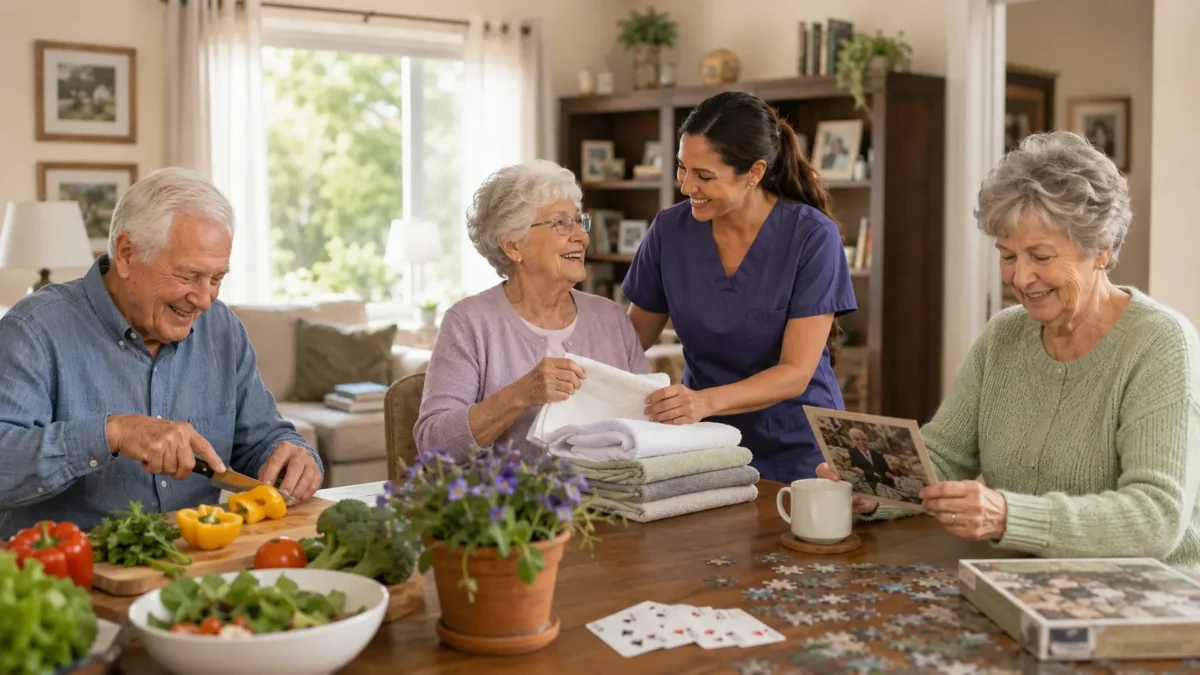
In a home-based assisted living environment, an activity might be:
- Helping prepare vegetables for dinner
- Watering flowers in the backyard
- Folding towels alongside a caregiver
- Helping prep food for the next meal
- Listening to favorite music
- Looking through family photographs
- Taking a short walk
- Baking cookies
- Playing cards
- Completing a puzzle
- Sitting outside with a cup of coffee
- Talking about grandchildren
- Decorating for a holiday
- Helping set the table
- Watching a favorite team
- Participating in gentle stretching or movement
These moments may appear ordinary.
That is exactly what can make them powerful.
A resident’s life before moving into an assisted living is rarely organized around an “activity calendar.” People cooked, cleaned, worked, gardened, visited friends, watched television, cared for children, listened to music, walked the dog, and completed hundreds of familiar tasks.
Moving into residential assisted living should not mean losing that sense of normal life.
Purpose Does Not Disappear With Age
One of the biggest mistakes senior care can make is assuming older adults need to be entertained.
Most people want something deeper.
They want to feel useful.
They want choices.
They want relationships.
They want opportunities to contribute.
They want to feel that their presence still matters.
A retired teacher may enjoy helping another resident with a word puzzle.
Someone who spent decades raising a family may enjoy helping fold laundry or preparing food.
A former gardener may light up when asked to water tomato plants.
Someone who spent every Sunday watching football may enjoy having a caregiver sit nearby and talk about the game.
The activity itself does not have to be complicated.
What matters is the connection between the activity and the person.
Home-based assisted living can provide an environment where routines, caregiver attention, and activities are adapted to individual abilities and preferences.
Why Smaller Environments Can Change Daily Life
One potential advantage of Denver home-based assisted living is scale.
In a smaller residential environment, daily life may feel more like living in a home than moving through a large senior living campus.
That difference can influence engagement.
Imagine two scenarios.
In one, an activity is scheduled for 10:00 a.m. in a room down a long hallway. A resident does not feel like attending at 10:00, so the opportunity passes.
In another, a caregiver notices that the resident is awake, alert, and interested in what is happening in the kitchen.
Instead of saying, “Activity time is over,” the caregiver can say:
“Would you like to help me make lunch?”
That is personalized engagement.
The activity fits the resident rather than requiring the resident to fit the schedule.
For families comparing assisted living options, caregiver availability and proximity deserve careful attention. Evaluating caregiver-to-resident attention can help families understand how much personalized interaction may actually occur throughout the day.
Familiar Routines Can Create Comfort
Daily routines matter at every age.
We wake up.
Drink coffee.
Read the news.
Eat breakfast.
Take a shower.
Walk outside or enjoy the garden.
Call someone we love.
Watch a favorite program.
Go to bed at a familiar time.
These routines help organize our days.
For an older adult moving into assisted living, maintaining familiar patterns can make a new environment feel less disruptive.
This is especially important when a person is already experiencing physical limitations, cognitive changes, grief, or the loss of independence.
Good daily activities assistance should therefore begin with questions.
What time does your father normally wake up?
Does your mother prefer coffee or tea?
Has she always enjoyed cooking?
Does he like mornings or evenings?
Does she enjoy being around groups, or does she prefer quieter one-on-one interaction?
Did he spend his life outdoors?
What music makes her smile?
What makes him feel useful?
The answers should influence care.
A person should not have to abandon a lifetime of preferences simply because assistance is now needed.
Caregivers Make Meaningful Engagement Possible
A calendar does not create engagement.
People do.
The caregiver who remembers that a resident loves Elvis creates engagement.
The caregiver who invites someone to sit outside because the weather is beautiful creates engagement.
The caregiver who notices a resident becoming restless and suggests a walk creates engagement.
The caregiver who knows Dad once owned a hardware store and asks his opinion about fixing something creates engagement.
This is where senior care services become personal.
Caregiving is certainly about completing essential tasks.
Residents may need help with bathing, dressing, grooming, toileting, medication routines, or mobility. Daily living assistance is an important component of senior care.
But exceptional caregiving asks another question:
Who is this person when we are not completing a care task?
That distinction matters.
A resident is not simply someone who needs assistance getting dressed.
She may also be a mother, grandmother, former nurse, traveler, gardener, Broncos fan, pianist, baker, or lifelong dog lover.
When caregivers know those details, care becomes more human.
What Families Should Look For During a Tour
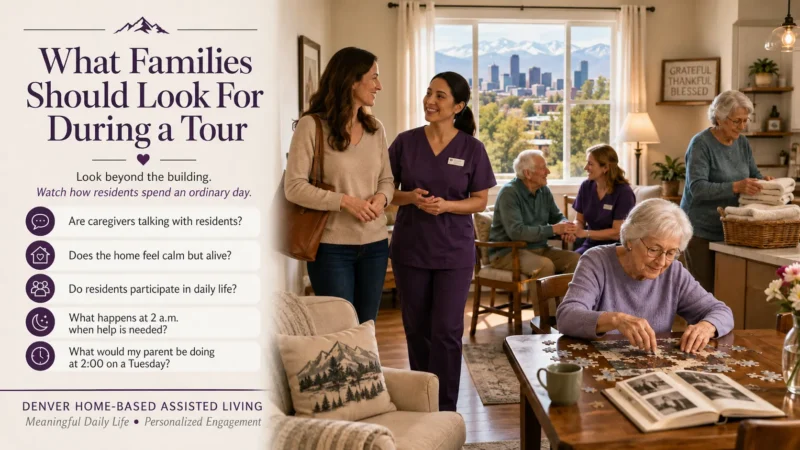
Adult children evaluating Denver elder care should ask to see more than bedrooms and dining rooms.
Pay attention to what residents are actually doing.
Are caregivers talking with residents?
Are residents sitting alone for long periods?
Does the home feel calm but alive?
Do caregivers appear rushed?
Are there personal connections between staff and residents?
Are residents participating in ordinary household life?
Can staff explain what individual residents enjoy?
Then ask direct questions:
“How do you learn what my parent enjoys?”
“What happens if Mom does not want to participate in the scheduled activity?”
What happens at 2 am when Mom needs help?
“Do caregivers provide one-on-one engagement?”
“What does a typical afternoon look like?”
“How do you engage residents who prefer quiet activities?”
“Can Dad continue hobbies he already enjoys?”
How is Dad engaged daily?
“How often do residents go outside?”
“Are activities adapted when someone’s abilities change?”
Perhaps the most revealing question is:
“What would my parent be doing here at 2:00 on an ordinary Tuesday?”
Listen carefully to the answer.
You are not looking for the longest activity calendar.
You are looking for evidence that staff understands how residents actually spend their days.
Families Should Feel Like Partners
Good assisted living should not separate families from care.
Families know that critical information is not always found in a medical record.
A daughter may know exactly which song calms her mother.
A son may understand why his father refuses to shower early in the morning.
A spouse may know that a resident becomes anxious in loud groups.
A granddaughter may know which family photographs spark conversation.
Those details matter.
Research on patient and family engagement recognizes the potential value of involving patients and families in care processes and outcomes.
Families should therefore look for communities where caregivers want to learn from them.
You should feel comfortable saying:
“Mom loves this.”
“Dad has never enjoyed that.”
“This routine usually works.”
“This is unusual for her.”
Good caregivers do not view those observations as interference.
They view them as information.
The Goal Is Not to Keep Someone Busy
There is an important difference between being occupied and being engaged.
A resident can sit in front of an activity without feeling connected to it.
Meaningful activity should support the individual.
Some days that may mean joining a group.
Other days it may mean listening to music in a favorite chair.
Sometimes it means exercise.
Sometimes it means helping cook.
Sometimes it means a quiet conversation.
Sometimes the most meaningful activity may be sitting outside together and enjoying the afternoon.
Success should not always be measured by how many programs someone attends.
The better question is:
Did this person experience connection, purpose, movement, enjoyment, or comfort today?
That is a much higher standard.
The Right Assisted Living Should Create Meaningful Days
Choosing Denver home-based assisted living is not simply about finding a place that can manage medications, prepare meals, or provide personal care.
It is about choosing how someone you love will live.
When you leave after a visit, you should not have to wonder whether Mom spent the entire day alone.
You should not have to wonder whether anyone knows what makes Dad laugh.
You should not have to wonder whether your parent is treated like a room number or recognized as a person with decades of experiences, preferences, habits, relationships, and stories.
Whether you are comparing in-home assisted living, traditional communities, or smaller residential assisted living homes, look beyond the building.
Look at the relationships.
Look at caregiver proximity.
Look at how residents spend ordinary moments.
Ask how activities are personalized.
Ask what happens between scheduled events.
Ask whether caregivers have enough time to sit, listen, encourage, and participate.
Because ultimately, families are not simply choosing a place for someone to receive care.
They are choosing where their loved one will wake up tomorrow morning—and what kind of day will be waiting for them.
That may be one of the most important questions you ask during your search for senior care.
For families comparing senior care services and residential assisted living in Denver, look beyond the building. Ask how caregivers get to know residents, how activities are personalized, and what an ordinary Tuesday afternoon actually looks like.
At Assured Senior Living, our small-home approach is designed around relationships, caregiver proximity, familiar routines, and personalized daily engagement.
If you are exploring assisted living for a parent or loved one in the Denver area, schedule a conversation or tour with Assured Senior Living. Come see what senior care can feel like when home, care, and meaningful daily life come together.