

Residential Memory Care Safety and Independence
When a parent is living with dementia, families often feel pulled between two priorities: keeping them safe and allowing them to remain as independent as possible.
It can seem like one goal must come at the expense of the other. More supervision may feel restrictive. More freedom may feel risky.
But well-designed residential memory care should not force families to choose between safety and dignity. The goal is to use attentive staffing, familiar routines, thoughtful design, and appropriate safeguards so residents can keep doing as much as they safely can.
For adult children comparing dementia care programs, the question is not simply, “Is this place secure?” A better question is, “How does this community use safety to support my parent’s independence? or even How does my parent thrive?”
What Does Safety Mean in Residential Memory Care?
Memory care safety is more than locked doors.
People living with dementia may experience changes in memory, judgment, orientation, communication, balance, and problem-solving. Everyday situations can become harder to navigate. Someone may become confused about where a hallway leads, misjudge a step, or attempt to leave because they believe they need to go to work or return home.
The Alzheimer’s Association notes that wandering or becoming lost can occur at any stage of dementia, making prevention and response an important part of care.
Strong residential memory care therefore treats safety as a system. Staffing, building design, routines, medication support, fall prevention, and emergency planning work together. The objective is not to eliminate movement or choice. It is to reduce preventable risk while preserving meaningful freedom.
1. Caregiver Proximity Can Support Safety and Freedom
One of the most important elements of secure residential care is the presence of caregivers who know residents well.
A resident may not always recognize that they need help or be able to explain what is wrong. Attentive caregivers can notice changes such as unsteadiness, reduced appetite, unusual restlessness, or withdrawal.
That proximity can make resident independence more possible. Instead of restricting a resident “just in case,” caregivers can stay nearby, offer a cue when needed, and allow the person to continue participating.
Families should ask how closely residents are observed, what the direct caregiver staffing ratios are, whether caregivers are consistently assigned, how staff responds when someone wants to walk, and what overnight supervision looks like.
2. The Physical Environment Should Make Safe Choices Easier
The design of a memory care setting can either create confusion or reduce it.
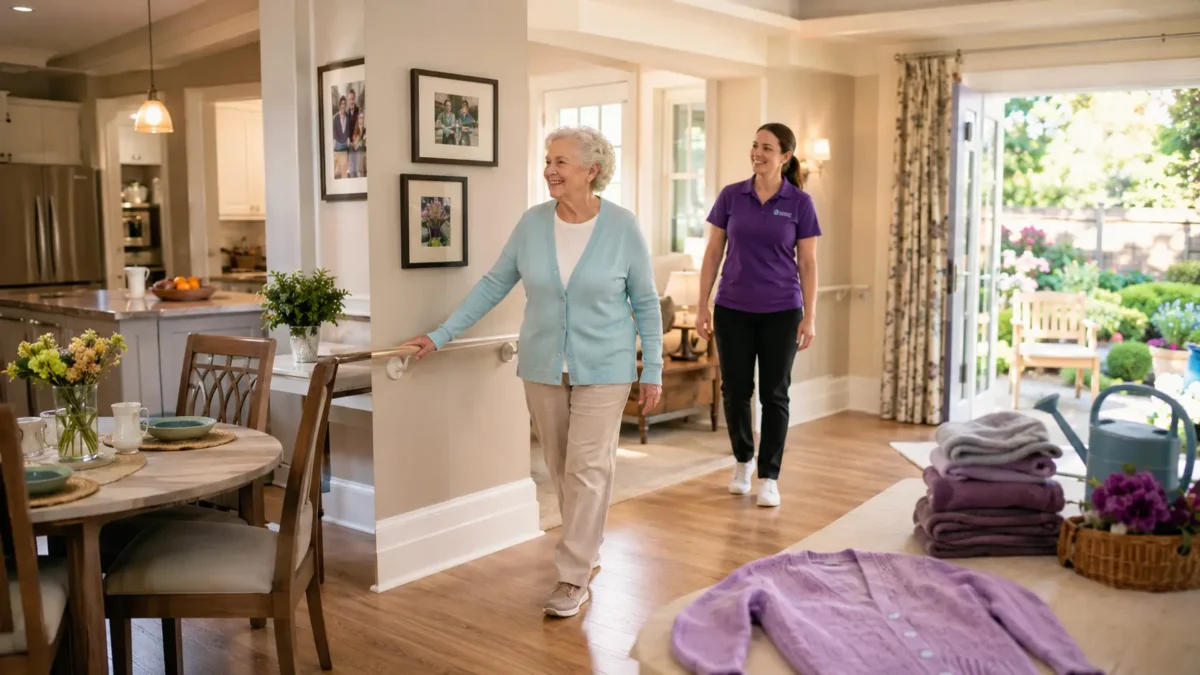
Clear walking paths, good lighting, uncluttered rooms, visual cues, accessible bathrooms, handrails, and secure outdoor spaces can help residents navigate the environment with less reliance on staff.
The National Institute on Aging recommends removing common trip hazards and modifying the environment to reduce safety risks for people living with dementia.
In residential memory care, those principles must be built into daily life. A resident who enjoys walking should not automatically spend the day seated because wandering is a concern. A thoughtfully designed setting may provide safe indoor pathways, an enclosed backyard, or supervised outdoor access.
A secure environment should create boundaries without making daily life feel unnecessarily confined.
3. Familiar Routines Can Reduce Confusion
Routine can be one of the most valuable forms of senior living support for a person with memory loss.
When the day follows a familiar rhythm, residents may experience less uncertainty. Breakfast happens in the same place, morning care follows a recognizable sequence, and meals and rest follow a familiar pattern.
The National Institute on Aging recommends maintaining familiar routines and adapting activities to a person’s abilities rather than removing participation altogether.
That may mean laying out clothing in order while the resident dresses independently. Someone may help set the table while staff handles hot cookware. A resident may water flowers, fold towels, stir batter, or choose music.
The task may look small, but the sense of purpose is not.
4. Independence Should Be Personalized
Dementia does not affect every person in the same way or at the same pace.
Good dementia care programs should avoid assuming every resident needs the same level of help. One person may dress independently but need help choosing weather-appropriate clothing. Another may walk confidently but need guidance finding the dining room.
Person-centered care focuses on abilities, preferences, history, and current needs rather than defining someone only by a diagnosis. The Alzheimer’s Association describes quality dementia care as care that responds to the individual’s unique experiences and needs.
During a tour, ask: “What will my parent still be encouraged to do for themselves?”
The answer can reveal the community’s philosophy toward resident independence.
5. Safeguards Should Match the Actual Risk
Some protections are essential. Exterior doors may need controlled access. Medications need secure management. Kitchens, tools, cleaning products, or certain outdoor areas may require supervision. Fall risks should be identified and addressed.
But safeguards should be thoughtful rather than automatic.
A resident who can safely use the backyard should not necessarily lose outdoor access because another resident requires closer supervision. A person who can choose between two outfits should still be offered that choice even if they need help with buttons or shoes.
The principle is to provide sufficient support to manage risk without undermining remaining abilities.
This is why individualized care planning matters. As dementia progresses, support should change with the resident rather than remain fixed.
6. Meaningful Choice Is Part of Independence
Independence is not limited to walking without help or completing personal care alone. It also includes choice.
Would you like breakfast now or in a few minutes? Would you rather sit outside or in the living room? Do you want the blue sweater or the green one?
Small choices preserve control in a life where others may increasingly make many decisions.
The National Institute on Aging recommends offering manageable choices during personal care and allowing people with Alzheimer’s to participate in tasks they can still perform.
Watch how caregivers speak to residents. Do they explain what they are doing? Offer choices? Wait for a response? Redirect respectfully when something is unsafe?
Dignity often appears in these small interactions.
7. Secure Residential Care Should Still Feel Like a Place to Live
Families naturally notice security features during a memory care tour. Also pay attention to daily life. Are residents moving naturally through the space? Can they safely access outdoor areas? Are caregivers nearby? Are residents participating in ordinary routines?
The best memory care safety strategies are often built into the environment.
A secure gate allows someone to garden. A clear hallway helps someone walk with confidence. A caregiver nearby makes it possible for someone to help prepare lunch. A predictable routine can reduce confusion.
Safety becomes the foundation that allows life to continue.
Questions Families Should Ask on a Memory Care Tour
Use questions that reveal how the program works in practice. Ask how the team determines what each resident can still do independently, how care plans change as abilities change, how frequent walking or exit-seeking is handled, what secure outdoor areas are available, how staff encourages participation in daily tasks, how fall risk is reduced without unnecessarily limiting movement, what nighttime supervision looks like, and for a real example of preserving independence while addressing a safety concern.
Specific answers can tell you much more than broad promises such as “We provide personalized care.”
As you tour, also watch what is happening around you. Are caregivers engaged with residents? Are people being encouraged to move and participate? Does the environment feel calm without feeling inactive? Do residents appear to be living in the space rather than being supervised within it?
Those observations can provide valuable clues about how a community approaches both safety and independence.
The Goal Is Appropriate Support, Not Maximum Restriction
Families often begin the memory care search because something has become unsafe at home. That concern is valid. Dementia can change judgment, orientation, mobility, and the ability to respond to emergencies.
But moving into residential memory care should not mean giving up every choice, responsibility, or familiar part of daily life.
Good care finds the balance. It protects where protection is needed, supports where help is needed, and steps back where the resident can still participate safely.
For adult children comparing dementia care programs, look beyond secured doors and activity calendars. Pay attention to caregiver proximity, environmental design, familiar routines, individualized support, meaningful choices, and staff interactions with residents.
The right residential memory care setting should help your parent stay safe without making safety the sole focus of the day.
Quality memory care is not only about preventing what could go wrong. It is also about preserving as much purpose, identity, connection, and independence as possible.
Ready to See the Difference?
If you are exploring residential memory care for someone you love, see how the right environment can support both safety and independence.
Schedule a tour of Assured Senior Living today and experience how our small-home approach helps residents feel known, supported, secure, and still part of everyday life.
Contact us today to start the conversation.